Introduction
There was a time when change in organizations happened in phases. A new process was introduced. A restructuring was announced. A technology upgrade was rolled out. Employees were given time to understand, adjust, and settle into the new way of working.
That world no longer exists.
Today, change is continuous. Markets shift faster, technology evolves rapidly, customer expectations change without warning, and organizations are forced to rethink strategy, structure, and execution more frequently than ever before. In this environment, the most valuable employees are not only those who know the most, but those who can learn, unlearn, adapt, and act quickly.
This capability is called change agility.
For organizations, change agility is not just a leadership competency. It is a people capability. It determines whether teams resist change, survive change, or use change as an opportunity to grow.
What Is Change Agility?
Change agility is the ability of individuals and teams to respond positively and effectively to change. It is not about blindly accepting every change. It is about staying open, flexible, curious, and solution-focused when circumstances shift.
A change-agile employee does not freeze when priorities change. They ask better questions. They look for new ways of working. They remain willing to learn. They can move from discomfort to action faster than others.
At an organizational level, change agility shows up when people are able to:
- Adapt to new business realities without losing momentum
- Learn new skills quickly and apply them in real work
- Stay productive even when ambiguity is high
- Collaborate across teams during transition
- Treat change as a normal part of growth, not a disruption
In simple terms, change agility is the mindset and capability to keep moving forward when the environment does not stay the same.
Why Change Agility Matters More Than Ever
Organizations today operate in a VUCA world: volatile, uncertain, complex, and ambiguous. In such an environment, fixed ways of thinking quickly become outdated.
The pandemic made this visible at scale. Employees had to shift from office-based to remote, then to hybrid work, and then to new ways of collaborating, communicating, and managing performance. For many people, this created change fatigue. They were asked to adjust repeatedly, often without enough emotional or practical support.
Even now, the pace of change has not slowed down. AI, automation, digital transformation, economic uncertainty, and evolving customer expectations continue to reshape how people work.
This is why organizations cannot treat change agility as a one-time training theme. It must become part of how people think, learn, and operate every day.
If employees are not prepared for change, every transformation becomes harder. Adoption slows down. Resistance increases. Leaders spend more time convincing people than executing strategy. Teams become reactive instead of proactive.
But when change agility is built intentionally, organizations become more resilient. People are better able to handle uncertainty. Teams recover faster from setbacks. Leaders can introduce new strategies with greater confidence because the workforce is more prepared to adapt.
The Real Challenge: People Are Tired of Being Told to Change
One reason change initiatives fail is that organizations underestimate the emotional load of change.
Employees are not machines. They do not simply receive a new instruction and immediately adjust. Every change affects habits, routines, confidence, identity, and sometimes even psychological safety.
When people have already experienced repeated change, they may begin to resist not because they disagree, but because they are tired. This is where many organizations make a mistake. They communicate change as a business requirement but fail to build the human readiness needed to support it.
Change agility requires more than communication. It requires trust, learning support, manager involvement, and space for people to experiment.
Employees need to believe:
“This change is not being done to me. I am being supported to move through it.”
That shift is critical.
The Role of Learning and Development in Building Change Agility
A strong Learning and Development function plays a central role in helping organizations become change-agile.
In many companies, L&D sits within HR and often carries multiple responsibilities. But if organizations want people to continuously adapt, learn, and grow, they need a dedicated focus on capability building. L&D teams are uniquely positioned to identify skill gaps, design learning interventions, support managers, and help employees build the mindset needed for change.
However, L&D itself must also become agile.
Traditional learning calendars are often too slow for modern business needs. By the time a program is designed and delivered, the business problem may already have shifted. Agile L&D requires faster diagnosis, iterative design, continuous feedback, and learning formats that can evolve with organizational needs.
A change-agile L&D function asks:
- What capability does the business need now?
- What skills will become critical next?
- How can learning be embedded into work instead of separated from it?
- How can employees practice change rather than just hear about it?
When L&D works this way, learning becomes a strategic enabler of transformation.
Why Organizations Must Stop Saying “This Is How We’ve Always Done It”
One of the biggest enemies of change agility is attachment to old methods.
Every organization has legacy practices. Some are valuable. Others continue only because they are familiar with it. The phrase “this is how we have always done it” often signals a deeper resistance to experimentation.
Change-agile organizations challenge this mindset. They encourage employees to question assumptions, test new approaches, and treat learning as an ongoing process. This does not mean abandoning structure or discipline. It means building a culture where improvement is expected.
Startups often do this naturally because they are forced to experiment. Larger organizations must intentionally create that same muscle. They must make it safe for employees to try, fail, learn, and adjust.
Without this mindset, organizations become rigid. They may continue executing efficiently, but efficiency in the wrong direction is still a risk.
Recruiting and Developing Agile Learners
Change agility begins even before employees join the organization.
Hiring only for current skill requirements is no longer enough. Roles evolve. Business models change. Technology changes how work gets done. A person who is perfect for today’s role may struggle tomorrow if they lack curiosity and learning agility.
Organizations should look for people who demonstrate:
- Curiosity about new ideas
- Openness to feedback
- Comfort with ambiguity
- Willingness to learn continuously
- Ability to adapt when plans change
But recruitment is only the starting point. Even agile learners need the right environment to grow. If the culture punishes mistakes, discourages experimentation, or rewards only compliance, agility will disappear over time.
That is why organizations must both hire for agility and develop agility.
How Change Agility Shows Up in Daily Work
Change agility is not only visible during major transformations. It appears in small daily behaviors.
A change-agile employee responds to a sudden client requirement by seeking solutions rather than blaming the situation. A change-agile manager helps the team understand why priorities shifted, rather than simply passing down instructions. A change-agile team reviews what isn’t working and adapts its approach rather than repeating the same process.
These behaviors may seem small, but they compound over time.
In organizations with strong change agility, people do not wait for perfect clarity before acting. They take informed steps, learn quickly, and keep adjusting. This makes execution faster and more responsive.
How to Build Change Agility in Employees
Building change agility requires a combination of mindset, skill, and practice. It cannot be achieved through a single motivational session.
1. Create Awareness Around Change Patterns
Employees need to understand how they personally respond to change. Some people resist openly. Others withdraw silently. Some become anxious, while others rush into action without enough thought.
Awareness is the first step. When people recognize their own patterns, they can begin to choose better responses.
2. Build Psychological Safety
People will not experiment if they fear punishment. Change agility requires a safe environment where employees can ask questions, raise concerns, and test new approaches.
Psychological safety does not remove accountability. It strengthens it by allowing people to speak honestly and learn faster.
3. Encourage Continuous Learning
Change-agile employees are continuous learners. Organizations must make learning accessible, relevant, and connected to real work. This includes workshops, coaching, peer learning, simulations, and on-the-job practice.
Learning should not feel like an interruption. It should feel like part of how work gets done.
4. Use Experiential Learning
Change cannot be understood only through theory. Employees need to experience uncertainty, make decisions, face consequences, and reflect on their behavior.
Experiential learning helps people practice change agility in a safe environment before real business pressure hits.
5. Reinforce Through Managers
Managers play a critical role in shaping how teams respond to change. If managers are anxious, unclear, or resistant, teams will mirror that behavior.
Organizations must equip managers to communicate change clearly, support their people emotionally, and create momentum during transitions.
Why Experiential Learning Is Powerful for Change Agility
Most people do not know how they respond to change until they experience it.
In a classroom discussion, everyone agrees that adaptability is important. But when pressure rises, resources are limited, time is short, and information is incomplete, real behavior emerges.
Some people take initiative. Some hesitate. Some collaborate. Some protect their own interests. Some ask for help, while others struggle silently.
This is why experiential learning is so effective for developing change agility. It provides employees with a realistic yet safe environment to practice adaptive thinking. They experience uncertainty, make decisions, and then reflect on what happened.
Reflection is where learning deepens. Participants begin to connect the simulation to workplace reality. They see how their choices, assumptions, and communication patterns affect outcomes.
This kind of learning stays because it is lived, not just heard.
How SimuRise Helps Organizations Build Change Agility
At SimuRise, we believe people do not change through information alone. They change through experience, reflection, and application.
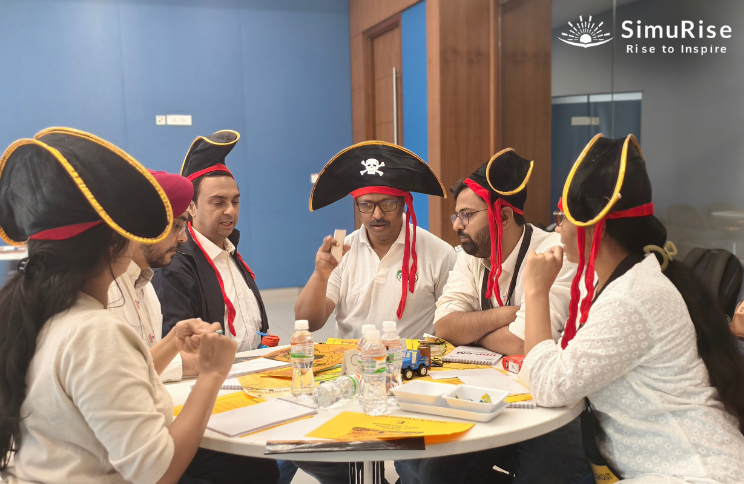
Our experiential learning interventions and business simulations create powerful environments where employees and leaders can practice change agility in action. Participants are placed in situations involving uncertainty, limited resources, shifting priorities, collaboration challenges, and decision-making pressure.
Through simulations such as The Quest for King Solomon’s Mines, The Search for the Lost Dutchman’s Gold Mine, FreshBiz, and Diamonds of Amazonia, teams experience the same dynamics they face at work: ambiguity, competing priorities, risk-taking, communication gaps, and the need to adapt quickly.
The simulation creates the experience. The facilitated debrief creates insight. The action planning creates the transfer back to work.
This helps organizations move beyond simply telling employees to “embrace change” and instead provides a practical, memorable, and reflective way to build that capability.
Conclusion
Organizations cannot control every market shift, technology disruption, or unexpected challenge. But they can build people who are better prepared to respond.
That is the real value of change agility.
It helps employees move from resistance to readiness. It helps teams move from confusion to collaboration. It helps leaders move from instruction to enablement. And it helps organizations move from reacting to change to using change as a competitive advantage.
In a world where the only constant is change, the strongest organizations will be those that develop people who can learn continuously, adapt confidently, and perform consistently through uncertainty.
If you want to build change agility in your people through powerful experiential learning and business simulations, reach out to us at marketing@simurise.com or call Annie at +91 9082381193. SimuRise can help your team’s experience change, reflect deeply, and build the mindset to move forward with confidence.