Introduction
- The market is changing.
- Competitors are moving faster.
- Customers expect better, quicker, and smarter solutions.
- The team knows action is needed.
But leaders hesitate.
They protect what already exists. They delay decisions. They ask for more data. They avoid risk. They wait for approval. They choose the safest option even when the business needs a stronger one.
On the surface, this may look like careful leadership.
But many times, it is not careful leadership.
It is a play-it-safe, not-to-lose mindset.
This mindset quietly shows up in many organizations. Leaders avoid bold choices because they do not want to be wrong. Managers delay decisions because they fear blame. Teams protect their own goals rather than collaborating toward the larger outcome. Innovation becomes a presentation topic rather than a daily practice.
The organization does not fail immediately.
But slowly, it becomes cautious.
Decisions slow down. Opportunities are missed. Teams stop experimenting. Leaders become defensive. Managers focus more on protecting performance than creating future growth.
This is why the playing to win mindset matters.
Playing to win is not about being reckless. It is not about ignoring risk. It is not about chasing growth without discipline.
Playing to win is about making clear choices, taking ownership, using resources well, collaborating across teams, taking calculated risks, and acting with courage toward a meaningful business outcome.
It is a leadership mindset that shapes strategy, culture, decision-making, execution, and long-term performance.
Quick Answer: What Is a Playing-to-Win Mindset?
A playing-to-win mindset is a leadership mindset in which leaders make bold, strategic, and responsible choices to drive growth, customer value, innovation, and long-term business outcomes.
A playing-not-to-lose mindset is defensive. It focuses on avoiding mistakes, protecting current performance, delaying decisions, and choosing safety over progress.
Organizations build a playing-to-win mindset by encouraging strategic choices, ownership, calculated risk-taking, collaboration, growth mindset, experimentation, decision-making under pressure, and reflection. Experiential learning and business simulations help leaders practice this mindset in realistic situations where decisions, risks, resources, and outcomes are visible.
What Is a Playing to Win Mindset?
A playing-to-win mindset is the ability to lead with clarity, courage, and commitment toward a defined outcome.
It means leaders do not only ask, “How do we avoid failure?”
They ask:
- What are we trying to create?
- Where do we want to win?
- What choices must we make?
- What trade-offs are required?
- What risk is worth taking?
- What customer value are we creating?
- What resources can we maximize?
- Who can help us win together?
- What must we stop protecting?
- What action is needed now?
This mindset is deeply connected to strategy.
A strategy is not just a plan. It is a set of choices. Leaders must decide where to focus, where not to focus, how to win, what capabilities to build, and what actions to prioritize.
Playing to win requires leaders to move from passive agreement to active choice.
- It requires ownership.
- It requires strategic thinking.
- It requires decision-making.
- It requires courage.
- It requires collaboration.
Most importantly, it requires leaders to believe that the goal is not only to avoid loss. The goal is to create meaningful progress.
Playing to Win vs Playing Not to Lose
The difference between playing to win and playing not to lose is not always visible in words.
Most leaders will say they want to win.
But the mindset becomes visible in decisions, conversations, risk appetite, speed, collaboration, and action.
| Playing to Win Mindset | Playing Not to Lose Mindset |
| Focuses on growth and value creation | Focuses on protection and safety |
| Makes strategic choices | Avoids difficult choices |
| Takes calculated risks | Avoids risk wherever possible |
| Looks for opportunities | Looks mainly for threats |
| Acts with ownership | Waits for approval |
| Learns from failure | Fears failure |
| Collaborates to win together | Protects individual or functional goals |
| Uses resources creatively | Hoards resources |
| Moves with speed and clarity | Delays decisions |
| Experiments and improves | Repeats what feels familiar |
| Builds future capability | Protects current comfort |
| Plays for business impact | Plays for safety |
Playing to win does not mean leaders ignore risk.
It means they understand risk and still make responsible choices.
Playing not to lose may look safe in the short term, but it often becomes costly in the long term.
Why Leaders Start Playing Not to Lose
Most leaders do not intentionally choose a defensive mindset.
They learn it from the system around them.
- If mistakes are punished harshly, leaders avoid risk.
- If senior leaders approve everything, managers stop deciding.
- If short-term numbers dominate every conversation, teams protect today and ignore tomorrow.
- If internal competition is rewarded, functions stop collaborating.
- If innovation is praised in speeches but rejected in decisions, people stop experimenting.
Over time, leaders become cautious.
They may still work hard. They may still attend meetings, manage targets, and complete tasks. But their energy shifts from creating outcomes to avoiding mistakes.
Here are the most common reasons leaders start playing not to lose.
1. Fear of Failure
Fear is one of the biggest reasons leaders play not to lose.
- They may fear being blamed.
- They may fear looking foolish.
- They may fear losing credibility.
- They may fear damaging their career.
- They may fear making a decision that does not work.
When fear outweighs purpose, leaders become defensive.
They delay decisions. They over-check. They escalate everything. They avoid bold ideas. They choose what is easiest to defend rather than what is most valuable for the business.
Fear does not always reduce effort.
It reduces courage.
2. Unclear Decision Rights
Many organizations tell leaders and managers to take ownership, but they do not clearly define what they are allowed to decide.
This creates hesitation.
A manager may think, “If I decide and it goes wrong, will I be questioned?”
So they wait.
They ask for permission. They pass decisions upward. They delay action until someone senior confirms the direction.
This creates a playing-not-to-lose culture.
Ownership cannot grow where decision rights are unclear.
3. Short-Term Performance Pressure
Short-term performance matters. Organizations need targets, discipline, and results.
But when short-term numbers become the only focus, leaders may stop investing in future growth.
- They avoid experimentation because it may affect this quarter.
- They avoid innovation because it may not show immediate returns.
- They avoid new opportunities because they may disturb current performance.
- They avoid people’s development because it takes time.
This mindset protects the present but weakens the future.
Playing to win requires leaders to balance today’s performance with tomorrow’s relevance.
4. A Culture That Punishes Mistakes More Than It Rewards Learning
If mistakes are remembered more than learning is encouraged, people become overly cautious.
They hide risks. They avoid experiments. They speak less. They choose safe options. They copy what others are doing. They avoid visibility.
This does not create excellence.
It creates fear.
A playing-to-win culture does not celebrate careless failure. But it does create space for thoughtful experimentation, learning, and improvement.
Leaders must distinguish between reckless risk and calculated risk.
Without that distinction, teams will avoid both.
5. Internal Competition and Silo Thinking
A playing-to-win mindset cannot survive in strong silos.
If every team is protecting its own target, leaders may stop thinking about the larger organization.
- Sales protects sales numbers.
- Operations protects capacity.
- Finance protects cost.
- HR protects policy.
- Technology protects timelines.
- Business units protect their own priorities.
Everyone may be working hard, but not everyone is working together.
Playing to win requires enterprise thinking.
The question should not be, “How does my function win?”
The question should be, “How do we win as one organization?”
6. Past Success Creates Comfort
Past success can become a trap.
- A business model worked earlier.
- A product dominated earlier.
- A process delivered results earlier.
- A leadership style was effective earlier.
So leaders continue doing the same thing even when the environment has changed.
Comfort feels safe, but it can slowly become dangerous.
A playing to win mindset requires leaders to keep asking:
“What made us successful so far may not be enough for what comes next. What must we change now?”
The 5 Leadership Traps of Playing Not to Lose
Under pressure, leaders often fall into predictable traps. These traps are dangerous because they can look responsible from the outside.
But inside, they slow the organization down.
1. The Safety Trap
The safety trap occurs when leaders choose what feels safe rather than what fosters growth.
They avoid difficult conversations. They avoid bold ideas. They avoid decisions that may create resistance. They keep doing what is familiar because it feels controlled.
Safety matters. But excessive safety creates stagnation.
A leader playing to win asks:
“What is the responsible risk we must take to move forward?”
2. The Approval Trap
The approval trap occurs when leaders and managers wait for a senior leader to approve every important move.
This may look like alignment, but often it is dependency.
When leaders fall into the approval trap, they stop using judgment. They focus more on what will be accepted than what is right for the business.
A leader playing to win asks:
“What decision can I own, and where do I truly need alignment?”
3. The Perfection Trap
The perfection trap happens when leaders wait for complete clarity before acting.
They want perfect data, perfect timing, perfect consensus, and perfect confidence.
But business rarely gives perfect conditions.
By the time certainty arrives, the opportunity may already be gone.
A leader playing to win asks:
“What do we know enough to decide, and what assumptions must we monitor?”
4. The Blame Avoidance Trap
The blame-avoidance trap occurs when leaders make decisions to protect themselves rather than the business outcome.
They choose the option that is easiest to defend. They follow the safest process. They avoid taking a stand. They make sure responsibility is spread so no one can be blamed.
This creates slow and defensive execution.
A leader playing to win asks:
“What is the right decision for the larger outcome?”
5. The Comfort Zone Trap
The comfort zone trap happens when leaders keep repeating what worked earlier even when conditions have changed.
This may happen because of pride, habit, fear, or lack of external awareness.
The comfort zone trap is dangerous because it feels familiar.
But future growth rarely comes from protecting old comfort.
A leader playing to win asks:
“What must we learn, unlearn, or change to stay relevant?”
The Business Cost of Playing Not to Lose
Playing not to lose may feel safe, but it creates hidden costs.
These costs often do not appear immediately. They show up slowly through weak execution, missed opportunities, low innovation, and defensive leadership behavior.
1. Slow Decision-Making
When leaders play not to lose, they delay decisions.
They wait for more data. They wait for approval. They wait for consensus. They wait for the right time.
The result is slow execution.
Teams become frustrated because they are ready to move, but decisions are stuck. Customers wait longer. Opportunities are missed.
Slow decision-making is one of the clearest signs of a defensive leadership culture.
2. Missed Opportunities
Opportunities rarely wait until leaders feel fully ready.
A new market, customer need, product idea, process improvement, partnership, or talent opportunity may require timely action.
When leaders play not to lose, they may avoid acting because the opportunity feels uncertain.
The biggest loss is not always a visible failure.
Sometimes, the biggest loss is the opportunity that was never pursued.
3. Weak Innovation
Innovation requires experimentation.
It requires leaders to test ideas, learn from feedback, and improve. But in a culture of not losing, experimentation feels risky.
People avoid new ideas because they do not want to fail. They repeat what is already approved. They wait for others to try first.
This leads to safe ideas, incremental thinking, and weak innovation.
4. Low Ownership
Playing not to lose reduces ownership.
People focus on protecting themselves instead of owning outcomes. Managers escalate instead of deciding. Teams wait for instructions. Leaders avoid accountability by keeping decisions vague.
Ownership grows when people are trusted to act, supported to learn, and expected to follow through.
Without ownership, strategy stays on paper.
5. Stronger Silos
Defensive leaders protect their own area.
They protect their team, budget, resources, information, and reputation.
This creates silos.
Instead of collaborating to create the best organizational outcome, teams focus on protecting their own position.
Playing to win requires leaders to break this pattern and build a one-organization mindset.
6. Reduced Customer Responsiveness
Customers feel the impact of defensive leadership.
When leaders delay, customers wait. When teams do not collaborate, customer experience becomes fragmented. When managers avoid decisions, customer problems escalate slowly. When teams protect internal processes, customer value suffers.
A playing-to-win mindset brings the customer back into the decision.
It asks:
“What does the customer need, and what must we do to create value?”
7. Weak Strategy Execution
Strategy execution depends on leadership behavior.
If leaders avoid choices, delay decisions, protect silos, and fear risk, strategy execution slows down.
A strategy may be bold at the top, but it becomes cautious in execution.
This is why playing to win is not only a mindset.
It is a strategy execution capability.
Real-World Examples of Playing to Win Mindset
The playing to win mindset is not only a training-room concept. It can be seen in how strong organizations make strategic choices, evolve business models, protect customer focus, and avoid complacency.
These examples are not about copying another company. They are about understanding leadership behavior
1. P&G: Strategy Means Choosing Where to Play and How to Win
One of the strongest business references on this topic comes from the strategic approach of A.G. Lafley and Roger Martin.
Their work around “playing to win” emphasized that strategy is about making choices: where to play and how to win. This is an important leadership lesson because many organizations confuse strategy with ambition.
Ambition says, “We want to grow.”
Strategy asks, “Where will we focus, how will we win, and what capabilities must we build?”
The leadership lesson is clear:
Playing to win is not vague optimism.
It requires choice, focus, trade-offs, and disciplined execution.
2. Amazon: Day 1 Thinking and Customer Obsession
Amazon’s Day 1 mindset is a strong example of avoiding complacency.
The idea is simple but powerful: organizations must continue to behave with the energy, curiosity, customer focus, and urgency of Day 1.
This is relevant to playing to win because defensive organizations often become comfortable. They protect what already works instead of staying close to customers and future opportunities.
The leadership lesson is:
Playing to win means staying externally focused, customer-obsessed, and willing to make bold long-term choices.
3. Microsoft: From Know-It-All to Learn-It-All
Microsoft’s cultural shift under Satya Nadella is often associated with a growth mindset and the movement from a “know-it-all” culture to a “learn-it-all” culture.
This connects strongly with playing to win because leaders cannot win in changing environments if they believe they already have all the answers.
A playing-not-to-lose mindset often protects expertise. A playing-to-win mindset builds learning agility.
The leadership lesson is:
Future-ready leaders do not protect old knowledge. They keep learning, unlearning, and improving.
4. Adobe: Choosing a New Business Model Instead of Protecting the Old One
Adobe’s move toward Creative Cloud and subscription-based offerings is a strong example of choosing long-term relevance over short-term comfort.
A company with a successful traditional software model could have protected the old way for longer. Instead, Adobe made a major shift in its business model toward recurring, cloud-based revenue.
That kind of shift requires leadership courage because transformation often creates short-term discomfort.
The leadership lesson is:
Playing to win sometimes means changing before the old model completely stops working.
5. Netflix: Moving Beyond the DVD Model
Netflix started with DVDs by mail, but its larger growth story is tied to its shift from that model to streaming.
The shift was not only a technology change. It was a mindset change.
A company playing not to lose may have protected the successful DVD model for too long. A company playing to win looks at where customer behavior is moving and evolves before it is forced to.
The leadership lesson is:
Playing to win means being willing to outgrow yesterday’s success.
6. Apple: Redefining the Phone With iPhone
Apple’s introduction of the iPhone is another example of bold category thinking.
Instead of treating the phone as only a calling device, Apple combined mobile communication, music, internet access, and a new touch interface into one product experience.
The leadership lesson is:
Playing to win often means redefining the game rather than competing only by the existing rules.
How Leaders Can Build a Playing to Win Mindset
A playing-to-win mindset can be developed, but it requires intentional leadership behavior and organizational support.
It cannot be created only through slogans.
Here are practical ways leaders can build it.
1. Define What Winning Means
Winning must be clear.
If leaders do not define what winning means, teams will create their own versions.
- For one organization, winning may mean customer trust.
- For another, it may mean profitable growth.
- For another, it may mean faster innovation.
- For another, it may mean entering new markets.
- For another, it may mean creating a one-organization mindset.
Leaders must define the outcome clearly.
Ask:
- What does winning mean for us this year?
- What does it mean for our customers?
- What does it mean for our teams?
- What business result are we trying to create?
- What behavior must change for us to win?
Clarity gives direction.
2. Make Strategic Choices
Playing to win requires choice.
Leaders must decide what to focus on and what to stop doing.
A team cannot win everywhere, for everyone, in every way, with the same resources.
Strategic choices may include:
- Which customer segments to prioritize
- Which products or services to invest in
- Which markets to enter
- Which capabilities to build
- Which behaviors to reward
- Which projects to stop
- Which risks to take
- Which old habits to leave behind
Avoiding choice feels comfortable, but it creates confusion.
Playing to win requires focus.
3. Build Psychological Safety for Calculated Risk
Leaders will not take calculated risks if every mistake is punished.
A playing-to-win culture needs psychological safety, but not carelessness.
The message should be:
“You are safe to think boldly, raise ideas, test assumptions, ask for help, and learn from mistakes. You are also responsible for making thoughtful decisions and following through.”
This balance is important.
Without psychological safety, people hide.
Without accountability, people drift.
Playing to win requires both.
4. Reward Ownership, Not Only Compliance
If organizations reward only compliance, people will play not to lose.
They will follow instructions, avoid risk, and protect themselves.
If organizations want a playing-to-win mindset, they must reward ownership.
Recognize leaders who:
- Take initiative
- Make thoughtful decisions
- Collaborate across functions
- Ask for help at the right time
- Share resources
- Take calculated risks
- Learn from failure
- Act for the larger business outcome
- Build future capability
What gets rewarded gets repeated.
5. Encourage Small Experiments
Playing to win does not always mean making one big bet.
Often, it begins with small experiments.
A team can test a new approach, pilot a process, try a new customer solution, experiment with AI, create a new collaboration rhythm, or run a short innovation sprint.
Small experiments help teams learn faster.
They reduce fear because failure becomes manageable.
They also create evidence for bigger decisions.
Leaders should ask:
“What is the smallest experiment that can help us learn quickly?”
6. Improve Decision-Making Under Pressure
A playing-to-win mindset requires decision confidence.
Leaders must learn to decide when information is incomplete and time is limited.
This does not mean rushing.
It means knowing how to:
- Clarify the goal
- Identify trade-offs
- Understand risks
- Make assumptions visible
- Involve the right people
- Decide with available information
- Review outcomes
- Learn and adjust
Decision-making under pressure is one of the most important leadership capabilities for organizations that want faster execution.
7. Build Collaboration Across Teams
Teams cannot play to win if they are playing against each other internally.
Collaboration is not just a soft skill. It is a business behavior.
A playing-to-win culture requires leaders to share information, resources, expertise, and support across functions.
Leaders should ask:
- Who needs to be involved?
- Who has already solved this problem?
- What resources can we share?
- Where are we optimizing locally but hurting the whole organization?
- How do we win as one organization?
Playing to win requires enterprise thinking.
8. Review Learning, Not Only Outcomes
Organizations often review results, but not learn.
A playing-to-win culture asks:
- What did we try?
- What did we learn?
- What worked?
- What failed?
- What assumptions were wrong?
- What will we do differently?
- What should we scale?
- What should we stop?
This helps teams become more adaptive.
If leaders only reward success and punish failure, people will hide learning.
If leaders review learning, teams become more courageous and intelligent.
Why the Playing to Win Mindset Must Be Experienced
You cannot build a playing-to-win mindset only by telling leaders to be bold.
They need to experience the cost of playing safe.
This is where experiential learning and business simulations become powerful.
In a business simulation, leaders may face limited time, limited resources, incomplete information, competition, uncertainty, and pressure.
Their natural mindset becomes visible.
- Some leaders may avoid risk.
- Some may wait for certainty.
- Some may fail to ask for help.
- Some may protect their team’s resources.
- Some may compete internally.
- Some may delay decisions.
- Some may focus only on immediate gains.
- Some may miss the larger goal.
Then the debrief creates insight.
Participants begin to see the connection between the simulation and their workplace.
They realize:
- “This is what we do in our projects.”
- “This is how we delay decisions.”
- “This is where we avoid risk.”
- “This is how we protect our function.”
- “This is where we fail to collaborate.”
- “This is where we play not to lose.”
This kind of insight is difficult to create through theory alone.
Experience reveals behavior.
Reflection creates awareness.
Application creates change.
How SimuRise Helps Leaders Build a Playing to Win Mindset
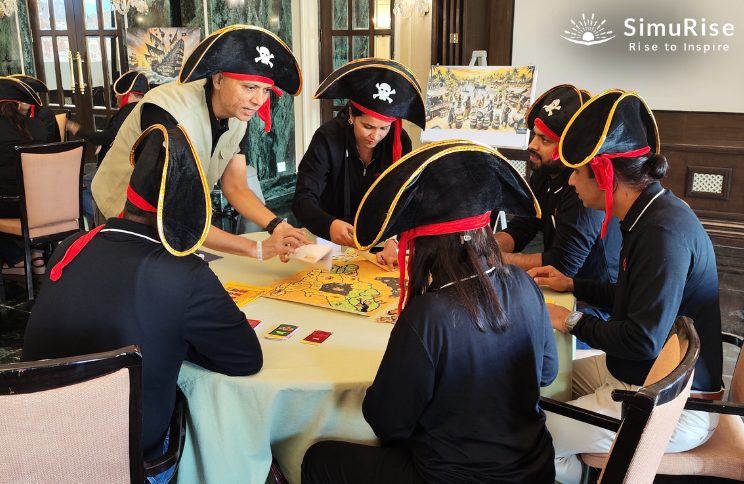
At SimuRise, we help organizations build playing-to-win behavior through experiential learning, business simulations, game-based learning, and facilitated reflection.
Our corporate training programs are designed to help leaders and managers experience real business behaviors in safe but challenging environments.
Through simulations and experiential learning workshops, participants practice:
- Strategic thinking
- Growth mindset
- Decision-making under pressure
- Calculated risk-taking
- Asking for help
- Resource maximization
- Collaboration
- Ownership and accountability
- Enterprise thinking
- Playing to win as one organization
This makes SimuRise relevant for organizations seeking corporate training solutions that go beyond awareness and drive behavior change.
Many learning and development companies and leadership training companies in India offer classroom programs. SimuRise’s strength lies in creating immersive business simulations that show leaders how mindset shapes outcomes.
The goal is not only to teach leaders the playing-to-win mindset.
The goal is to help them see where they are playing, what they must change, and how to avoid losing.
SimuRise Business Simulations That Support Playing to Win Behaviors
The Quest for King Solomon’s Mines
This simulation helps leaders experience collaboration, strategic thinking, growth mindset, asking for help, resource maximization, playing to win, and ownership.
Participants must make choices, use resources wisely, collaborate under pressure, and work toward the larger goal.
It is useful for leadership offsites, management development programs, strategy meetings, and future-ready leadership development programs.
The Search for The Lost Dutchman’s Gold Mine
This simulation helps teams experience collaboration over competition, trust, planning, communication, resource management, and shared success.
It is powerful for organizations where teams compete internally rather than working together to win as one organization.
FreshBiz
FreshBiz helps participants develop entrepreneurial thinking, opportunity spotting, innovation, proactivity, resourcefulness, and multidimensional thinking.
It is useful for leaders who need to move beyond limitations and identify new opportunities.
Diamonds of Amazonia
Diamonds of Amazonia helps virtual and hybrid teams practice decision-making, resource management, collaboration, productivity, and agility.
It is useful for distributed teams that need to build stronger decision-making and collaboration behaviors.
Square Wheels to Round Wheels
Square Wheels to Round Wheels helps leadership teams identify obstacles, bottlenecks, silos, and behaviors that are slowing execution.
It helps teams convert problems into practical solutions and action commitments.
Accelium-Based Problem-Solving Games
Accelium-based games help participants practice decision-making, analytical thinking, flexible thinking, resilience, planning, and problem-solving.
They are useful for organizations that want structured game-based learning to build future-ready thinking skills.
Is Your Organization Playing to Win or Playing Not to Lose?
Use these questions as a leadership diagnostic.
Ask yourself:
- Do leaders delay decisions because they fear being wrong?
- Are teams choosing safe options instead of bold opportunities?
- Do managers wait for senior approval too often?
- Are people afraid to experiment?
- Are failures punished more than learning is discussed?
- Are leaders protecting current performance instead of building future capability?
- Are teams working in silos?
- Are people avoiding calculated risks?
- Is innovation discussed but not practiced?
- Are employees rewarded for compliance more than ownership?
- Do leaders focus only on short-term targets?
- Are teams missing opportunities because they are trying not to fail?
- Do managers hesitate to make decisions under pressure?
- Are people afraid to ask for help?
- Do teams protect resources rather than share them?
- Are leadership offsite activities creating energy but not changing behavior?
- Are corporate training programs creating awareness but not action?
If many of these are true, your organization may not have only a strategy problem.
It may have a mindset problem.
Playing to Win Mindset Checklist for HR and L&D Leaders
Use this checklist before designing a leadership development intervention.
Strategy and Direction
- Do leaders understand what winning means for the organization?
- Are strategic priorities clear?
- Are leaders making choices or avoiding trade-offs?
- Are teams aligned around shared outcomes?
- Is there clarity on where to play and how to win?
Decision-Making
- Do leaders make timely decisions?
- Are decision rights clear?
- Do managers avoid unnecessary escalation?
- Are teams able to act with incomplete information?
- Are decisions reviewed for learning?
Risk and Innovation
- Are calculated risks encouraged?
- Are experiments supported?
- Is failure reviewed for learning?
- Are teams encouraged to challenge old ways of working?
- Are leaders building future capability?
Collaboration and Enterprise Thinking
- Do teams share resources?
- Are functions working toward shared goals?
- Do leaders ask for help across teams?
- Are silos being addressed?
- Is enterprise thinking encouraged?
Ownership and Accountability
- Do leaders take responsibility for outcomes?
- Are people rewarded for ownership?
- Are action commitments reviewed?
- Do leaders follow through?
- Are behaviors linked to business outcomes?
Key Takeaways
Playing to win is a leadership mindset focused on growth, value creation, strategic choices, ownership, and responsible action.
Playing not to lose is a defensive mindset focused on avoiding mistakes, protecting current performance, delaying decisions, and choosing safety.
Leaders often play not to lose because of fear, unclear decision rights, short-term pressure, low psychological safety, internal competition, and comfort with past success.
The business cost of playing not to lose includes slow decisions, missed opportunities, weak innovation, low ownership, silos, poor customer responsiveness, and weak strategy execution.
A playing-to-win mindset must be built through clarity, calculated risk-taking, experimentation, collaboration, learning, and action.
Experiential learning and business simulations help leaders experience the cost of playing safe and reflect on what needs to change.
SimuRise helps organizations build playing-to-win behaviors through business simulations, experiential learning workshops, and leadership development interventions.
Conclusion: Leaders Shape Outcomes by the Way They Choose to Play
Every organization has a choice.
It can play not to lose.
Or it can play to win.
Playing not to lose may feel safe. It protects current performance, avoids visible failure, and reduces short-term discomfort. But over time, it can lead to slow decision-making, defensive teams, missed opportunities, and weak innovation.
Playing to win requires more courage.
- It asks leaders to make choices, take ownership, collaborate, learn, experiment, and act with clarity.
- It does not mean ignoring risk.
- It means facing risk with judgment.
- It does not mean being reckless.
- It means being responsible for the future.
The strongest leaders are not the ones who avoid every mistake. They are the ones who know what matters, make thoughtful choices, involve the right people, take calculated risks, and keep learning.
That is the leadership mindset organizations need to build.
If your organization wants to build a playing-to-win mindset through experiential learning, business simulations, and leadership development interventions, SimuRise can help.
To explore business simulations, corporate training programs, experiential learning workshops, and leadership interventions for your teams, reach out to marketing@simurise.com or connect with Annie at +91 9082381193.