Introduction
Today, organizations view their employees as an asset worth investing in.
- Organizations’ training calendar is filled with a wide variety of training courses and development programs.
- Leaders of organizations typically attend multiple leadership development programs throughout the calendar year.
- From the outside, it appears that the organization has successfully scaled its learning opportunities and use of training.
However, when organizations evaluate their learning outcomes, an uncomfortable truth emerges.
- Skills are developed but are not actually retained.
- Insights are developed; however, they are not consistently used over time.
- Potential is identified, but not fully realized.
The issue is not the amount of investment organizations have provided; rather, it is the type of investment.
Organizations often provide short-term learning (training) and then expect it to create long-term capabilities.
That gap – between investment and realized results – is where performance has diminished.
The Reality: Capability Is Built Over Time, Not Events
Corporate Learning Has A Fundamental Misunderstanding
The fundamental misunderstanding of corporate learning is that companies believe that if employees have access to appropriate content, it will lead to change and improved performance. For instance, many organizations believe that if their employees attend training programs featuring the right models or are provided with the right materials (populations), those employees will perform at a higher level in their jobs.
However, capabilities are not built this way.
Capabilities are built over time through:
1. Repeated exposures to challenges
2. Continuous practice in the real world
3. Reflection on past successes and failures
4. Gradual refinements in behavior.
A single training course will raise participants’ awareness of an issue. However, without an opportunity for repeated practice, participants are unlikely to implement any of those ideas in their daily behavior.
Therefore, long-term development is important as it supports how people actually develop.
Why Short-Term Development Fails to Deliver
One way to see why short-term approaches continually fail is to look at the evidence of the importance of long-term investment.
Firstly, there is a lack of continuity, with most learning interventions being stand-alone events. There are no planned follow-ups or continuation after the process starts. Therefore, when learning has occurred, it dissipates quickly.
Secondly, there is no application of learning as employees return to unchanged workplaces after programs. With no opportunity to practice new behaviors, they revert to established habits.
Thirdly, there is the issue of behavioral inertia. The habits that we have developed over the years cannot be replaced by intermittent exposure to new ideas. Without regular exposure to new ideas and sustained reinforcement, old habits will continue to dominate.
Finally, most organizations measure attendance and completion at the end of the intervention; however,r they seldom measure whether behavior has changed or performance has improved.
The result is always the same: Learning is seen to be occurring, but very little true transformation takes place.
The Strategic Shift: From Training to Development
Organizations that are beginning to outperform others in this space are making a fundamental shift.
They are moving from:
- Training → Development
- Programs → Journeys
- Knowledge → Capability
- Events → Systems
This shift recognizes that learning is not something employees attend—it is something they engage with continuously.
Long-term development is not about doing more training.
It is about designing a system where growth becomes inevitable over time.
What Long-Term Development Actually Looks Like
When organizations invest in long-term development, the focus moves beyond content delivery to capability building.
Instead of asking, “What should we teach?”, the question becomes:
“What kind of leaders and employees do we need to build over time?”
This shift changes everything.
Development becomes:
- Continuous rather than episodic
- Applied rather than theoretical
- Personalized rather than generic
- Measured through behavior rather than attendance
Employees are not just learning;g they are evolving.
The Compounding Advantage of Long-Term Investment
The cumulative nature of long-term growth is one of the more common overlooked contributions to it.
The returns from short-term learning are linear — you spend time and resources and initially get a boost in either your skills or your knowledge that will only last for a while.
Long-term growth is nonlinear (i.e., they create an exponential effect) and creates positive results as employees:
- Repeatedly implement their learning,
- Obtain continuous feedback,
- Evaluate their own learning, and
- Change their behavior as needed.
An employee’s ability to develop rapidly not only makes them capable but also advances them to the employee’s group.
The ability of the employee to engage in continuous learning also enables:
- Improved decision-making under adverse circumstances,
- Improved ability to collaborate across the organization,
- Increased accountability and ownership for one’s own success, and
- Increased ability to change.
As employees become more adept at their jobs, the ripple effect can create substantial change throughout the entire organization.
The Impact on Business Performance
Long-term employee development is not just an HR initiative. It is a business strategy.
Organizations that invest in sustained development often see:
1. Stronger Leadership Pipelines
Instead of relying on external hiring, organizations develop leaders internally who understand the business deeply and can step into larger roles seamlessly.
2. Improved Execution Consistency
When employees build habits over time, execution becomes more reliable. Plans are not just created; they are delivered.
3. Higher Employee Engagement and Retention
Employees are more likely to stay in organizations that invest in their growth. Development signals trust, commitment, and long-term opportunity.
4. Greater Organizational Agility
As employees become more adaptable, the organization itself becomes more responsive to change.
5. Cultural Alignment
When development is continuous, values and behaviors are reinforced regularly, leading to stronger alignment across teams.
These outcomes are not immediate,e but they are sustainable.
The Role of Learning Journeys in Long-Term Development
Long-term development does not happen automatically. It requires intentional design.
This is where learning journeys play a critical role.
A learning journey structures development over time, ensuring that employees move through stages of:
- Awareness
- Practice
- Reflection
- Application
- Reinforcement
Instead of delivering everything at once, it allows for gradual building.
It also integrates multiple elements of experiential learning, coaching, feedback, and real-world application, creating a system that supports continuous growth.
In many ways, learning journeys are the operational model that makes long-term development possible.
Why Experiential Learning Accelerates Development
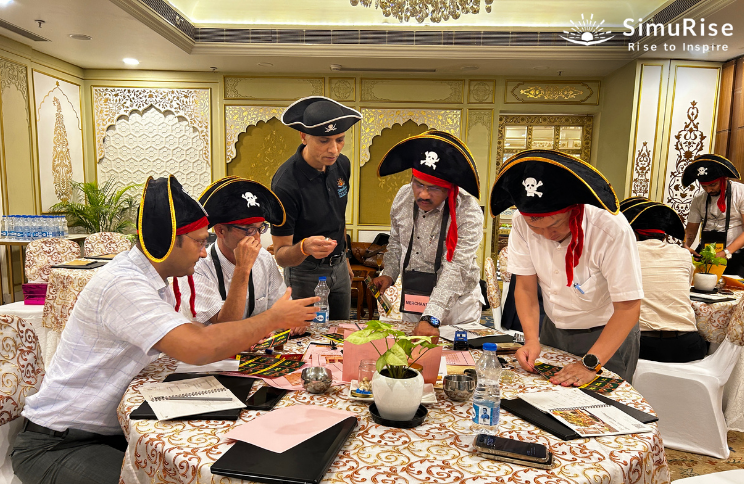
Experiential learning is a highly effective way to reinforce long-term development.
Experiential learning is fundamentally different than conventional learning. In experiential learning, employees are placed in realistic situations where they can act, make decisions, and collaborate with one another.
Experiential learning accomplishes two things:
– It helps identify an employee’s real behavior versus their perceived behavior. It shows the employee’s reactions and behaviors under pressure, their areas of hesitation, and how they act and interact with the people around them.
– It causes emotional connections to be formed. The learning process through experience will be remembered by people far more than anything else they have been told, and with the addition of reflection and reinforcement, experiential learning greatly speeds up development.
The Organizational Challenge: Commitment to the Long Term
Long-term development offers several benefits; however, many organizations lack both the patience and commitment to it.
The implementation of short-term projects is generally much easier than that of long-term projects because they coincide with calendar dates, provide immediate outputs, and generate visible activity.
Long-term development requires:
- Continuous funding
- Alignment with leadership
- Ongoing measurement
- Integration into the organization’s culture
Therefore, organizations must be willing to look beyond quarterly outcomes and invest in capability development that may take time to fully mature.
Organizations that commit to long-term development will gain a competitive advantage that cannot be easily replicated.
Conclusion: The Organizations That Win Think in Years, Not Sessions
The future of work will not be defined by access to knowledge. Knowledge is already abundant.
It will be defined by how effectively organizations build and sustain capability.
Short-term training can no longer meet this need.
Organizations must move toward long-term development in which employees are not just trained but continuously shaped, challenged, and supported in their growth.
Because in the end, the strongest competitive advantage is not strategy, technology, or scale.
It is the quality of thinking and behavior across the organization.
And that can only be built over time.
Final Thought
If organizations want different results, they cannot rely on the same approach to development.
The question is no longer:
“How many programs are we running?”
The real question is:
“Are we building people who can consistently perform at a higher level over time?”
Because that is where real transformation and real competitive advantage begin.
📩 marketing@simurise.com
📞 Annie: +91 9082381193