Introduction
For years, corporate training has followed a familiar pattern. Employees enter a room, listen to a facilitator, go through slides, discuss a few examples, and leave with new ideas. The session may be engaging. The feedback forms may look positive. Participants may even say, “This was useful.”
But a few weeks later, the real question appears: what actually changed?
Did teams collaborate better? Did managers make stronger decisions? Did leaders take more ownership? Did employees apply what they learned when pressure returned to the workplace?
In many organizations, this is where the gap becomes visible. Traditional training often creates awareness, but awareness does not always translate into behavior change. People may understand what needs to be done, but still fall back into old habits when deadlines, pressure, uncertainty, and conflicting priorities return.
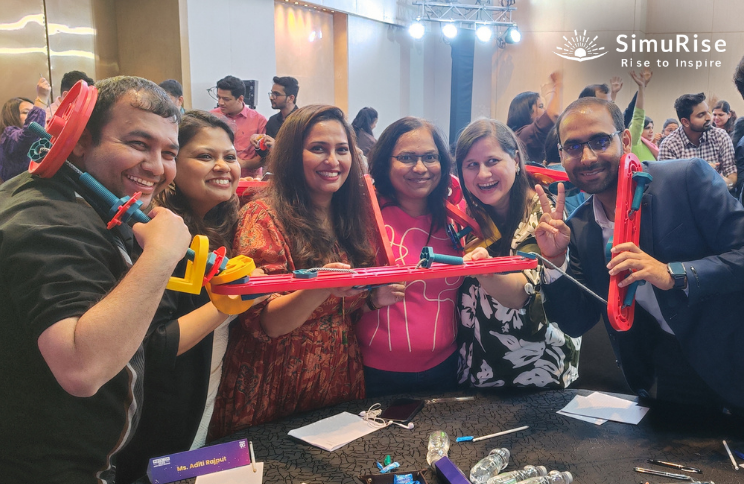
This is why experiential learning in corporate training is becoming increasingly important. It shifts learning from passive understanding to active experience. Instead of only telling people what collaboration, agility, ownership, or decision-making look like, experiential learning allows them to practice these behaviors in realistic, safe, and engaging environments.
In a business world where change is constant and future-ready skills are critical, experiential learning is no longer just a creative training format. It is becoming one of the most effective ways to build lasting capability.
What Is Experiential Learning in Corporate Training?
Experiential learning is an approach in which people learn by doing, reflecting, and applying. It places participants in situations where they must make decisions, solve problems, collaborate with others, and experience the consequences of their actions.
In corporate training, this can take many forms, such as business simulations, role-plays, leadership labs, gamified learning, scenario-based exercises, action-learning projects, and team challenges.
At its core, experiential learning follows a simple but powerful cycle:
- Experience: Participants engage in a realistic challenge or activity.
- Reflection: They pause to examine what happened and why.
- Insight: They connect the experience to workplace behavior.
- Application: They identify what they will do differently back at work.
This cycle matters because people rarely change just because they hear a good idea. They change when they experience something that makes them see themselves, their decisions, and their impact more clearly.
Why Traditional Corporate Training Often Falls Short
Experiential learning is a way of educating individuals through direct involvement in real-world experiences, reflection on those experiences, application of what they have learned, and then performing in a new manner as a result of those lessons. To facilitate the learning process, participants are placed in realistic situations where they must make decisions, solve problems collaboratively, and experience the outcomes of their actions.
In corporate training, many experiential learning methods can be used, including business simulations, role-playing, leadership labs, gamified learning, scenario-based exercises, action learning projects, and team challenges.
The experiential learning cycle consists of four interrelated phases. Participants begin by experiencing a realistic challenge or problem. Afterward, they take time to reflect on their experience by examining what happened during the challenge and what led to that outcome. They then realize how they can relate their experience back to their work behaviors. Finally, participants identify ways that they will change their behavior at work as a result of their experience.
The importance of the experiential learning cycle is that few people change their behavior or sense of self simply because someone presented them with a good idea. Change comes to individuals as a result of experiences that give them greater clarity about themselves, the decisions they make, and the consequences of those decisions.
Why Experiential Learning Matters More Than Ever
Employees and leaders in the modern workplace require a different set of skills than those needed in the past. While technical skills remain valuable, they are no longer sufficient on their own. Organizations now require individuals who can think critically, adapt quickly to changing circumstances, collaborate effectively with cross-functional teams, and make decisions amid uncertainty.
These characteristics cannot be developed by simply listening to someone speak; these competencies require experience through practice.
Experiential learning is particularly relevant as it supports the development of the higher-order capabilities required for successful job performance, including but not limited to:
- Strategic Thinking – Participants develop the ability to ‘see the whole board’ rather than only acting on what is in front of them.
- Decision-Making Under Pressure – Teams practice making decisions with limited amounts of time and insufficient information resources.
- Collaboration – Participants see how their collective work impacts the outcome, as opposed to each working in ‘silo’-type environments.
- Ownership/Accountability – Participants recognize how their actions can impact future outcomes.
- Change Agility – As Teams learn to adapt and adjust when faced with new plans, resources, or changing conditions.
These are becoming critical competencies to possess because the business environment has become faster, more complicated, and unpredictable than ever before. Organizations require employees who can react intelligently to changing conditions and not just carry out instructions.
How Experiential Learning Creates Real Behavior Change
Experiential learning is powerful for two reasons: it combines the mind and heart (the source of motivation) in a way that many people fail to realize, and it creates deeper levels of awareness. When someone actively participates in the activity, they are personally involved. This participation leads to greater awareness.
For example, when a team loses in a simulation because they did not share information, it is not a learning experience based on theory. It is a real experience of the results of poor information sharing. When a team doesn’t have a chance to win because they were too cautious, they see the impact of a survival mindset firsthand. When a team evolves through asking for help and collaborating with others, they know that collaboration is a driver of performance, not just a value statement.
An effective experiential learning intervention generally operates in three phases.
1. Demonstrates Actual Behavior
Most people have an idealized perception of themselves as collaborative, strategic, and/or agile. However, when they are placed in a situation with an artificial time constraint or uncertainty, their true patterns become evident.
In this respect, experiential learning acts as a mirror for the participant – the learning process helps the participant to see who they really are and how they actually behave, rather than what they believe they do.
2. Emotional Ownership Is Created
Participants become more engaged in the experience when they see the outcomes of their decisions. As a result, the individual gets the information firsthand by experiencing the outcomes and no longer gets feedback from an outside person.
3. Developing Greater Ownership & Willing to Transform
Developing the Unity Between Understanding & Action, participants can convert their understanding into concrete action steps for themselves during the debriefing process upon returning to their jobs. Based on the experience and subsequent discussions, they can also create meaningful connections to their workplace.
What Experiential Learning Looks Like in Practice
Think about how a leadership team works together in a business simulation and is required to achieve a common goal with very limited resources. Initially, leaders/management teams focus only on how to achieve the goal and may act in ways that compete for resources with other teams, be reluctant to share information, and have difficulty asking for help when needed.
As the simulation progresses, they begin to realize that just because they achieved their individual goals does not mean they achieved their overall organizational goals. The teams that chose to cooperate, share resources, plan strategically together, and work together to achieve a common goal achieved the best performance.
The teams learned a critical, or magical, lesson: Silos diminish performance.
Now think about a group of managers completing a decision-making simulation and required to make quick decisions with limited information. Some managers spend excessive time analyzing the information and will never reach a decision. Some managers make quick decisions. Some wait for direction or guidance. Some accept ownership of their decisions and adjust to the changing environment.
During the debrief, the facilitator connects these behaviors to similar behaviors in the workplace. Suddenly, the learning becomes applicable. The managers begin to ask themselves these questions:
- Where do we take too much time making decisions at work?
- Where do we compete internally with one another instead of collaborating/working together to achieve a common goal?
- When do we play it safe instead of taking a calculated risk?
- Where do we wait to see how things turn out instead of creating a clear pathway to the outcome?
These inquiry-based questions are beneficial to each manager because they are grounded in their own work experience. The managers are not being told what they are doing wrong; rather, they are discovering the reality of their actions for themselves.
The Benefits of Experiential Learning for Organizations
In many ways, experiential learning provides value at various levels of your organization, including employees, teams, leaders, and the workplace itself. The main benefits include:
1. Increased engagement: When people take part in an experiential learning activity, they are more engaged and less likely to become disengaged from the learning experience.
2. Greater retention: People typically remember real-life experiences longer than they do when they are simply listening to someone talk about a subject or seeing a slide presentation on a subject.
3. Increased ability: to connect learning to real-world problems; this allows for the application of the knowledge gained to actual work-related problems that arise in the office.
4. Increased collaboration: Team members learn the importance of effective communication, having trust in one another, and working together towards a shared goal.
5. Increased leadership capacity: Participants learn how to make decisions, take responsibility for their own actions, and develop strategic thinking skills.
6. Aligned workplace culture: Participants experience and understand a common language regarding values and behaviors.
7. Accelerated behavior change: Participants leave the learning process with a clear understanding of their behaviors and are more likely to take action on that understanding.
The single greatest benefit of experiential learning is that it turns the process of gaining knowledge from “understanding to doing”. And in corporate environments, “doing” is truly what matters.
Why Experiential Learning Is Critical for Leadership Development
Leadership is not tested when conditions are easy. It is tested when people face pressure, uncertainty, conflict, and trade-offs.
This is why leadership development benefits strongly from experiential learning. It allows leaders to practice real leadership behaviors in a safe environment before they face similar situations in business.
A good leadership simulation can reveal whether leaders:
- Communicate clearly under pressure
- Ask for help when needed
- Collaborate beyond their own teams
- Balance risk and reward
- Take ownership of outcomes
- Think strategically instead of reacting tactically
These are difficult to measure in traditional training. But in experiential learning, they become visible.
For organizations developing future leaders, high-potential employees, managers, and senior leadership teams, this visibility is extremely valuable. It helps L&D teams move beyond attendance and participation to focus on actual behavioral capability.
Where Experiential Learning Can Be Used
Experiential learning is not limited to one type of program. It can be used across many organizational development needs.
It is especially effective for:
- Leadership development programs
- Management development journeys
- Team-building and team-development interventions
- Leadership offsites and strategy meets
- Onboarding and culture-building programs
- Change management workshops
- Collaboration and communication interventions
- Future-ready skills development
- Sales and customer-centricity programs
The common factor is this: experiential learning works best when the goal is not just knowledge transfer but also behavior change.
How SimuRise Brings Experiential Learning to Corporate Training
At SimuRise, we believe people do not change through information alone. They change through experience, reflection, and application.
Our business simulations and experiential learning interventions are designed to help leaders and teams see their real behaviors under pressure. Through simulations such as The Quest for King Solomon’s Mines, The Search for the Lost Dutchman’s Gold Mine, FreshBiz, Diamonds of Amazonia, and Square Wheels to Round Wheels, participants experience challenges around collaboration, strategic thinking, decision-making, resource optimization, ownership, and change agility.
These simulations create safe but powerful environments where teams can practice the behaviors organizations need most. They make decisions, face consequences, reflect on their actions, and identify what must change back at work.
- The simulation creates the experience.
- The facilitated debrief creates insight.
- Action planning creates the bridge to real-world workplace application.
This is what makes experiential learning more than an engaging activity. It becomes a catalyst for business transformation.
Conclusion
Corporate training is reaching a critical juncture. Organizations cannot rely solely on content-heavy training; they must also incorporate experiential learning to create a lasting impact.
The future capabilities required to succeed at work include adaptability, collaboration, strategic thinking, imagination, resilience, responsibility, and decision-making. These capabilities can only be developed through experiential learning, which provides individuals with hands-on experiences that facilitate the transition from knowing to doing.
Experiential learning allows the transition from passive to active learning. It enables both individuals and teams to observe their own behavior, reflect on how their behavior affects others, and find new ways to perform their tasks.
As work continues to change, organizations that invest in experiential learning will be more likely to develop leaders ready for the future, build teams with stronger bonds, and foster a culture of adaptability.
If you want to bring experiential learning into your corporate training programs, leadership offsites, onboarding journeys, or capability development initiatives, reach out to us at marketing@simurise.com or call Annie at +91 9082381193. SimuRise can help your teams learn by doing, reflect deeply, and apply insights that create measurable business impact.