Introduction
In most organizations, leaders get recognized for their individual-level accomplishments within their respective departments. Sales leaders are recognized for creating revenue; finance leaders are recognized for creating margins and controlling the financial resources of the company; operations leaders are recognized for creating operational efficiency; HR leaders are recognized for creating the people, capability, and culture of the company; and technology leaders are recognized for creating new technology systems at fast speeds.
Functional excellence, or creating a highly effective department, is important to the overall success of any organization and a “must-have.” However, if each leader thinks only from the perspective of their department, the organization and its customers will begin to feel the effects of misalignment.
As departments focus only on their own work and do not share resources with one another, they will start to build silos. This leads to resource protectionism, conflicting department priorities, and teams optimizing for their own organization rather than for the whole organization. Ultimately, the customer experience will become fragmented because they will encounter different departments within your organization.
That’s why enterprise thinking is so critical today.
Enterprise thinking is the ability to look at the big picture beyond your role, team, department, or organization and make decisions in the best interests of the whole organization. It involves understanding how your role and the roles of others create organizational value; the interconnectivity between your role and all other functional roles within your organization; how different customer touchpoints create a common experience for the customer; and how decisions made in one functional area impact the overall business enterprise performance.
Enterprise thinking is no longer limited to those in top leadership positions due to the rapid changes occurring in the business community. Leaders and managers at every level need to understand the business, think cross-functionally, and act like owners.
What Is Enterprise Thinking?
The transition from “my function” (functional mindset) to “our organization” (enterprise mindset) is the definition of enterprise thinking. For example, a functional leader typically evaluates results by asking, “What is best for my team, department, or target?” On the other hand, an enterprise leader will make their decision based on the question:
“What is best for the business, the customer, and the long-term success of the organization?”
That does not mean a functional leader should disregard the functional responsibilities of the business; rather, a functional leader must connect those responsibilities to the larger business agenda and recognize that the organization operates as an interconnected system, where each area affects others.
For instance, a decision made in sales has an impact on the delivery of items, while a decision made in finance has an impact on the investment used to create a product; a decision made in operations has an impact on the customer experience, or a decision made in HR can have an impact on the capabilities/culture/execution of the organization. Enterprise thinking will be an asset to a leader when considering and evaluating the connections between these subject areas. Enterprise thinking will enable a leader to view strategy, customers, markets, financial outcomes, talent, resources, innovation, and execution as an integrated part of the overall business system.
Why Enterprise Thinking Has Become a Leadership Priority
Business is faster, more complicated, and more unpredictable today. Decisions can’t just wait for the CEO/senior leadership team anymore. Organizations must make fast decisions at multiple levels.
This means that leaders and managers throughout the company must understand the business well enough to make informed decisions without having to keep going back to the higher-ups.
Leaders and managers need to know:
- How does the business make money?
- What are their customers’ real values?
- How does the company compete with other companies?
- What drives cost, profit, cash flow, and growth?
- How does strategy connect with day-to-day operations?
- How does the business change affect what is important to the company?
- How does my department/function contribute to overall company results?
When leaders do not understand these fundamental areas, decision-making happens in isolation. For instance, a manager might make a decision that is good for their department but might hurt the customer experience; a department might protect its budget, but another department that’s always had budget problems ends up not being able to spend what it needs; a team might hit its own key performance indicator, but the wider company misses their goal.
Enterprise thinking allows leaders to have a broader perspective and helps them think beyond the immediate effects of their actions/decisions on their own function and the entire organization.
Functional Mindset vs Enterprise Mindset
When looking to really grasp how one operates in an enterprise context, comparing it to viewing it solely through a functional, very valid problem-resolution lens is one approach. As leaders grow and others look forward in their quest to become better leaders, relying solely on a functional, problem-solving model will, at some point, limit leaders’ effectiveness as they attempt to resolve an organizational issue.
A truly functional leader attempts to protect their department’s priorities, with the expected outcome of protecting their department’s interests, regardless of the organization’s needs or priorities. The truly functional leader measures success only by the scoreboard of their department’s achievements. Truly functional leaders will go out of their way to avoid sharing their employees, data, or departmental resources for fear of affecting the people’s comfort . The truly functional leader views their department as competitive with other departments, rather than as a partner.
A leader operates as an enterprise leader, has their leadership team as their first team, and their department as their second team. An enterprise leader will frequently ask the question, “What does our business need the most right now?” An enterprise leader collaborates across department lines. An enterprise leader understands and is willing to make trade-offs in resolving issues. Therefore, an enterprise leader is willing to set aside their functional bias if it will create a better overall enterprise-level outcome.
Consider the example of a group of senior executives who are trying to prioritize an excessive number of final initiatives. All the departments will fight to have their projects prioritized based on a functional-only mindset. Every department is going to argue that they have the most pressing needs, and thus, when the organization finally settles on how many initiatives to pursue, it ends up with too many, no vision, poor planning,g and poor execution.
With an enterprise mindset, leaders evaluate priorities based on customer impact, strategic importance, resource availability, long-term value, and organizational capacity. They make choices together. They align around fewer, sharper priorities. Execution becomes clearer.
That is the difference enterprise thinking creates.
The Three Foundations of Enterprise Thinking
Enterprise thinking is not just a mindset. It is also a capability. Leaders need to build three core foundations: strategy understanding, market orientation, and financial literacy.
1. Understanding Strategy
Leaders must understand how the organization plans to create and capture value. They need to know what the strategy is, why it matters, and how their decisions support it.
Many employees know their tasks but do not understand the strategy behind them. This creates mechanical execution. People work hard, but they may not work in the right direction.
When managers understand strategy, they can explain priorities better, align their teams, make better trade-offs, and connect daily work to business outcomes.
2. Market and Customer Orientation
Enterprise thinking requires leaders to keep the customer at the center.
Customers do not care how the organization is structured internally. They do not experience departments separately. They experience the organization as one whole system.
When leaders think from the customer’s perspective, they naturally move beyond silos. They begin asking better questions:
What does the customer need?
Where is the customer experiencing friction?
How do our internal handoffs affect the customer?
What market shifts should we prepare for?
Where are new opportunities emerging?
A strong market orientation helps leaders stay alert to competition, customer expectations, industry change, and future opportunities.
3. Financial Literacy:
Not every leader needs to become a finance expert, but every leader must understand the financial impact of decisions.
Financial literacy helps leaders understand revenue, cost, margin, cash flow, profitability, return on investment, and business trade-offs.
For example, winning a large deal may look like success. But if the cost of servicing that deal exceeds the revenue it generates, it may not be a true win. Similarly, reducing costs in one area may create quality problems, customer dissatisfaction, or employee burnout elsewhere.
Enterprise leaders understand that business decisions must make strategic, customer, operational, and financial sense.
Why Leaders Struggle to Build Enterprise Thinking
Although Enterprise Thinking may appear easy, it is not easy in practice. There are several ways that Enterprise Thinking is challenging to practice. First, most organizations incentivize functional performance by promoting leaders who successfully meet their assigned functional targets and by developing expert leaders within their functional areas. Through this process, leaders gain extensive knowledge of their own functions but lack a broader understanding of the enterprise as a whole.
Secondly, many leaders lack exposure to the other functions of the business. For example, the Marketing leader may not have a strong understanding of Operations; the Finance leader may not understand customers’ pain points; and the Technology leader may not have a deep understanding of the challenges faced by those on the front lines of execution.
Thirdly, many leaders have competing incentives so long as they are measured solely on their functional objectives. Thus, they will most likely protect functional objectives. To practice Enterprise Thinking, however, all functions must operate under a model of shared goals, shared accountability, and shared success measures. Finally, Enterprise Thinking requires a level of maturity in a leader. Leaders must be willing to let go of their ego, control, and functionally defensive mindsets to practice Enterprise Thinking. In addition, leaders must be willing to collaborate, influence others, listen, and make decisions for the greater good.
How to Build Enterprise Thinking in Leaders and Managers
Enterprise thinking can be developed intentionally. It should not be left to chance or limited only to senior executives.
1. Help Leaders Understand How the Business Works
Leaders need exposure to the full business model. They should understand how the organization creates value, serves customers, makes money, manages costs, competes in the market, and delivers results.
This can be done through business simulations, cross-functional learning sessions, financial literacy programs, customer immersion, and strategic discussions.
The goal is to help leaders connect their role to the whole business system.
2. Place the Customer at the Center of Decisions
Customer orientation is one of the fastest ways to break functional thinking.
In meetings, leaders can ask:
How will this decision affect the customer?
Which part of the customer journey will improve?
Where are we creating friction?
What would we do differently if we thought as one organization?
Some organizations use a simple psychological anchor, such as an empty chair in meetings, to represent the customer. This reminds leaders that the real purpose of enterprise thinking is not internal alignment alone, but better value creation.
3. Create Shared Goals Across Functions
Enterprise thinking becomes difficult when every function has isolated targets.
Organizations should create shared goals that require collaboration. These may include customer experience, innovation, revenue growth, cost optimization, speed to market, employee engagement, or strategic execution.
When success depends on cross-functional outcomes, leaders begin to think beyond their own department.
4. Build Cross-Functional Relationships
Enterprise thinking improves when leaders know each other beyond job titles.
Leaders should spend time understanding other functions’ goals, pressures, constraints, and contributions. This reduces assumptions and builds trust.
Cross-functional projects, leadership alignment meetings, peer learning groups, and enterprise problem-solving sessions can help leaders develop these relationships.
Strong relationships make collaboration easier when pressure increases.
5. Develop Business Acumen and Financial Understanding
Business acumen is the language of enterprise leadership.
Managers should be able to understand basic financial statements, key business metrics, market realities, customer value, and strategic trade-offs. They should be able to ask better questions about cost, revenue, growth, profitability, and long-term value.
This helps them move from task execution to business contribution.
6. Use Simulations and Experiential Learning
Enterprise thinking cannot be built only through lectures. Leaders need to experience what happens when decisions are made in silos, when resources are hoarded, when teams compete internally, or when short-term thinking damages long-term results.
Business simulations create a safe environment where leaders can practice enterprise thinking. They face realistic challenges, make decisions, experience consequences, and reflect on their behaviors.
This makes the learning practical and memorable.
7. Reinforce Enterprise Behaviors in Meetings
Meetings are where functional or enterprise mindsets become visible.
Leaders can reinforce enterprise thinking by asking:
- What is the enterprise impact of this decision?
- Which teams will be affected?
- Are we optimizing locally or globally?
- What does the customer need?
- What is the long-term consequence?
- Where do we need to share resources or information?
These questions slowly build new habits of thinking.
Benefits of Enterprise Thinking
Enterprise thinking benefits organizations by making them more effective and connected. Collaboration improves because leaders no longer view departments as roadblocks. Improved decision-making results from a better understanding of the broader implications of each decision. Additionally, resource utilization is enhanced by increased teams’ willingness to share talent, knowledge, and assistance with one another.
Enterprise Strategy execution improves when functions are aligned toward the same objective. Enterprise Innovation is increased through improved flow of ideas across departmental lines. Furthermore, Enterprise Customer Experience will improve as the Enterprise functions as a single coherent system rather than a series of disconnected parts.
Enterprise Thinking will also provide significant improvements for every individual leader. Enterprise Thinking will make leaders more valuable, more strategic, and more ready to take on senior leadership positions. Leaders who possess a deeper understanding of their organization’s business beyond their own functional area will ask better questions, influence more effectively, and make greater contributions.
Real-Life Example: From Functional Expert to Enterprise Leader
Imagine being a leader with many years of experience in the marketing industry. As a marketing leader, you possess deep knowledge about brands, campaigns, customers & their insights, communication, etc. However, as you transition into a larger leadership position (with more responsibility), you need to gain knowledge across many areas (finance, operations, sales, people, technology, strategy, etc.) to lead effectively across all functions of an organization.
If you limit how you think as a marketing expert, you will limit your ability to make an impact. However, if you expand your thinking to understand how marketing is tied to sales conversion, operational delivery, customer experience, revenue, and profitability, you will become a more well-rounded business leader.
This example illustrates the transformational journey from functional expertise to enterprise leadership.
Likewise, if you are a finance leader who only understands numbers, you may miss valuable insights into the people, customers, and operations behind those numbers. Once a finance leader develops the ability to think with an enterprise mindset, they will be able to leverage their financial knowledge to support better business decisions across the entire organization.
To conclude, the concept of enterprise thinking does not limit functional expertise; it provides breadth beyond functional expertise.
How SimuRise Can Help Build Enterprise Thinking
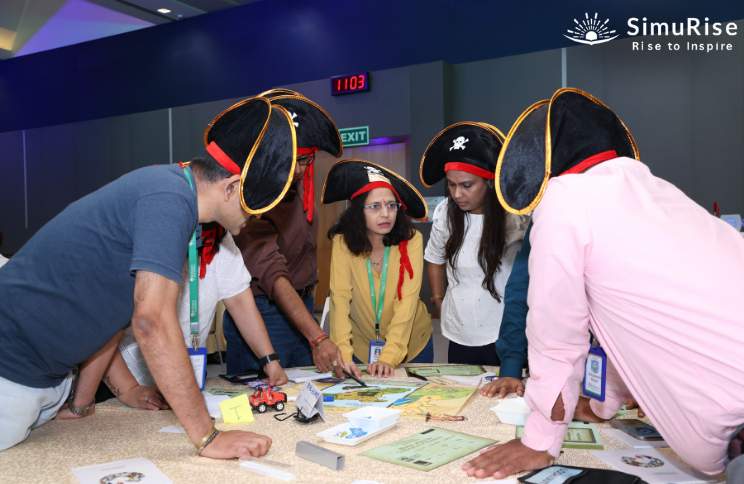
SimuRise provides organizations with the tools to cultivate an enterprise mindset through immersion in a business simulation, industrial experience, workshop, and leadership journey environment.
Through simulation, leaders have opportunities to think beyond their own team, collaborate, leverage resources, make strategic decisions, manage constraints, respond to uncertainty, and align around a common goal.
For example, Quest For King Solomon’s Mines (or, alternatively, Quest For The Gold) shows the difference between working in silos and working together as one organization; the importance of asking for assistance; how to leverage available resources; how to play to win; how to respond to uncertainty; and how to set alignment with the overarching purpose.
Search For The Lost Dutchman’s Gold Mine teaches leaders how to emphasize collaboration over competition, develop a strategic plan, manage resources effectively, and build trust in leadership by working toward an aligned outcome.
Using FreshBiz as a platform for developing an entrepreneurial mindset, finding opportunities, being resourceful, and having the ability to make decisions proactively.
Square Wheels To Round Wheels provides insight into organizational roadblocks, challenges to outdated or inefficient systems, and ways to co-create impactful and effective solutions for the whole organization.
Leaders will see their behaviors through experience and reflection; they will identify areas where they are competing, with whom they collaborate, where they are thinking in a limiting fashion, and how they can become more strategic in their actions.
This is how enterprise thinking moves from concept to capability.
Key Takeaways
- Enterprise thinking is the ability to make decisions for the organization as a whole, not just for one function.
- Functional excellence is important, but functional thinking alone can create silos, resource hoarding, and fragmented execution.
- Enterprise leaders understand strategy, customers, markets, financial impact, and cross-functional interdependence.
- Enterprise thinking should be developed at all levels, not only among executives.
- Business simulations and experiential learning are powerful ways to help leaders practice enterprise thinking in realistic situations.
- Organizations that build enterprise thinking improve collaboration, decision-making, strategy execution, customer experience, and leadership readiness.
Conclusion: The Future Belongs to Leaders Who Think Beyond Their Function
The CEO should not be the only person thinking about the whole organization.
In a fast-moving business environment, every leader and manager must understand how their decisions affect the larger enterprise. They must be able to think beyond department goals, collaborate across boundaries, and act in the best interest of customers, people, and business outcomes.
Enterprise thinking does not happen automatically. It must be intentionally developed through exposure, shared goals, cross-functional collaboration, business acumen, reflection, and experiential learning.
The leaders who grow in the future will not only be functional experts.
They will be enterprise thinkers.
And organizations that build this capability early will be better prepared to execute strategy, serve customers, innovate faster, and grow stronger.
To build enterprise thinking in your leaders and managers through experiential learning and business simulations, reach out to marketing@simurise.com or connect with Annie at +91 9082381193.