Introduction
Many organizations view competition as a good thing. Leaders within these organizations often believe that some level of rivalry amongst teams, departments, and business units will push people to perform at a higher level, innovate faster, and produce better results. Ordinarily, that belief is reasonable based on the following logic: Competition creates urgency; it motivates an individual to perform at a higher level; and it causes teams to raise their quality standards.
However, when internal competition continues for an extended period, it tends to be detrimental to large organizations.
As time goes by, teams develop subtle resistance to internal competition (e.g., delaying decision-making, hoarding information, duplicating work, changing agendas, initiating open conflict between teams). Employees that were originally competing with external players start to compete with each other; employees who ought to be focused on putting the customer first have begun to focus on defending their own territory; employees who would normally share resources have begun to defend their own resources; and employees who would normally be working together to solve problems have instead started to work against each other to support their own departments being more important than another department’s.
At this point, it becomes extremely costly for the organization.
Costs related to internal competition do not always appear under the expense line item on corporate financial statements. Instead, many of them appear as opportunities never pursued, ideas never shared, projects never completed, and employees who left the organization without making any noise. Just as opportunities for growth were not realized because the investment was not made in a timely manner, and subsequently there was no balance sheet entry, the above examples of costs incurred by an organization will have significant, long-lasting implications for the organization’s overall growth, culture, innovation, and long-term performance.
What Is Internal Competition?
The term internal competition refers to rivalry occurring within an organization among individuals, teams, departments, functions, or business units. Internal competition generally arises from limited resources (budgets, leadership attention, promotions, talent, recognition, and strategic initiatives are not available equally to all).
While a certain level of internal competition is expected, as many employees want to do well and will work hard to succeed, these inclinations do not pose an issue until internal competition becomes ingrained in an organization’s default operating system.
When individuals begin perceiving their coworkers as competitors rather than partners in achieving the company’s larger goals, the collaborative environment created through teamwork will start to fade away; when departments are forced to compete against each other for visibility, they may stop sharing information on projects; when individual teams are rewarded based solely on achieving their own specific targets, they will likely ignore the company wide impact of their work; and when leaders utilize all available resources to solely benefit their functional area, the inefficiencies created within other areas of the organization will continue to grow.
Destructive forms of internal competition cause employees to focus on achieving their objectives, while distracting them from pursuing the overall business objective.
Why Internal Competition Becomes Toxic in Large Organizations
Complexity is inherent to large organizations. They include multiple functions, layers, geographies, reporting structures, priorities, and stakeholders. In these types of environments, internal competition can develop quietly as teams have different goals, scorecards, and pressures.
For example, a sales team may be focused on speed; an operations team may emphasize the stability of processes; a finance team, on controlling costs; a technology team, on scalability; and an HR team, on the capability and culture of their teams. Each of these functions may be doing what they feel is right and, in doing so, creating misalignment in their priorities that can lead to teams unintentionally working against one another.
The problem is usually not that people are bad; it is that the systems reward narrow success.
If leaders are rewarded only for functional performance, they will naturally do what is required to protect those functional outcomes. If the KPIs that teams are measured on are only individual-based, they may not consider how their decisions impact other teams. If the most visible team or group is recognized and rewarded, it may be more attractive to self-promote than to cooperate with others.
Thus, there could be a cultural perception of support for collaboration, but day-to-day behaviors may tell a different story.
The Visible and Invisible Costs of Internal Competition
Some visible costs of workplace competition may include delays, escalations, or poor coordination, all of which can be observed in meetings, project timelines, and operational reviews.
However, there are invisible costs that will have an even greater effect on the general workplace.
The above-mentioned are examples of the many areas where internal competition will adversely affect performance; however, the most damaging aspect is when individuals do not feel comfortable sharing their ideas for fear of being ridiculed by a co-worker. The lack of communication between teams creates customer service problems because of finger-pointing. Very often, highly skilled employees will leave an organization because of its perceived political culture. There are also often strategic opportunities lost due to delays in alignment between functions. The project selected is not always the one that is best for the organization; rather, it is the one with the strongest internal advocate.
These are generally referred to as ‘omissions’ in organizations. Omissions do not occur because the right actions are not performed; there are simply cases where individuals do not take the right action.
This shows how dangerous internal competition can be. While it can sometimes create a lot of noise by diminishing performance, it is equally capable of silently (and thus incrementally) preventing the emergence of any performance improvements.
1. Loss of Productivity
The major costs of competition also relate to productivity, as teams lose output when they compete internally. The time and effort that team members spend defending their decisions, attending alignment meetings that do not lead to action, preparing political arguments, protecting resources, and managing perceptions will hinder project execution.
Stakeholders cannot agree, resulting in project delays. Teams are trying to protect their interests, so decisions are delayed. Meetings last longer because people are negotiating power instead of solving problems.
Often within organizations, one department performs the same work as another because of a lack of communication about what each department is doing. For example, two departments may have both created similar tools; or there are 2 different business units that are each working independently to solve the same customer’s problem; or two teams are running parallel initiatives without enough knowledge of what one another is doing.
This duplication wastes money & time, as well as the talent of the employees doing the work.
One method for estimating the amount of productivity lost due to competing with other departments is to track the number of delayed decisions, abandoned initiatives, repeated projects, unresolved dependencies, and meetings that end without clear next steps or ownership of action items.
2. Poor Communication and Information Hoarding
Teams hoard information out of fear of being outdone by others who have the same information. When teams see that having information is tantamount to power, they will not share. As a result, they will keep customer insights, market intelligence, process knowledge, and project updates from each other because they fear that if they share that information, other teams will use it against them.
Poor communications impact decisions and hinder effective functioning of the overall company by creating situational ambiguity. Due to the lack of an open flow of information, teams cannot make complete and accurate decisions. They make guesses and duplicate work on projects. They do not understand the priorities. They miss out on potential support from one another.
Poor communication also creates distrust among teams. If a team member believes another team member is hiding something from them or working purely out of self-interest, that will reduce collaborative efforts among teams. Every decision will take longer than necessary as teams question one another’s motives.
When organizations are in a high-trust culture, information flows freely throughout the organization; in a competitive culture, it gets trapped.
3. Delayed Decision-Making
Large organizations generally find it difficult to make decisions quickly due to hierarchy, complexity, and multiple stakeholders involved in the decision-making process. Internal competition can further exacerbate this problem.
As departments compete with each other, decisions are no longer evaluated on their business merits but are instead assessed based on factors such as influence, ownership, politics, and the decision-maker’s visibility. For example, a good idea may be blocked because it came from the “wrong” department, whereas a practical solution may be delayed by another function attempting to gain credit for it. Also, a move-up in priority may be made by a more powerful stakeholder simply because they have pushed their agenda.
As a result, the organization’s agility is affected.
In rapidly changing markets, slow decision-making can lead to lost revenues. Customers will not wait for the organization’s resources to align, and competitors will not wait while internal debate takes place over ownership of that opportunity. Therefore, an organization can miss opportunities in the marketplace while its teams are negotiating internally.
To enable faster movement within an organization, internal friction caused by multiple departments must be reduced so that decisions can be made more quickly.
4. Lower Innovation
Sharing ideas, challenging the status quo, bringing together different views, and building on others’ strengths support an innovation culture, but internal competition kills it.
When working in a competitive environment, a person’s instinct is to protect their idea from criticism and/or theft by not sharing it in its early stages. Additionally, they don’t get involved in other functions of the organization, as they feel that collaborating poses a risk. Instead, they value safe, dumb ideas that make them look good rather than brave, innovative ideas that require them to share credit and/or the success or failure of the idea.
This creates a non-existent pipeline for innovative ideas.
A collaborative culture allows for ideas to cross boundaries. An organisation that creates a competitive culture will see their ideas trapped within the silos of the organisation.
To determine whether a culture is collaborative or competitive, an organization can track the number of cross-functional initiatives initiated, the number of collaborative ideas implemented, and/or the number of innovation-related projects abandoned due to misalignment.
5. Weakened Culture and Trust
Every day shapes culture based on what employees see within the workplace. When employees repeatedly witness departments competing, managers blaming one another, teams not providing assistance to one another, or only individuals receiving recognition for success, they will quickly learn how the system works. They will learn to develop ways to protect themselves. They will learn to avoid any form of risk or take chances. They will learn not to ask others for assistance. They will develop the understanding that being correct and having accurate information is more important than collaborating with co-workers. This leads to an erosion of trust both in the organization and among employees.
A low-trust culture can be emotionally costly for the business. Employees will often expend energy in the workplace managing internal political issues rather than performing meaningful work. In addition, employees will be more cautious, frustrated, and disengaged due to low levels of trust. Ultimately, this experience can impact overall morale and employee performance.
Trust is not merely a “soft” cultural value; it is a key enabler of the organization’s overall success. When trust levels are high, work is performed more efficiently and completed more promptly. Conversely, when trust levels are low, all work tasks require considerable effort.
6. Higher Employee Turnover
While some employees may remain with an employer for the salary, benefits, or name recognition, the real reason they continue to work for that employer is that they feel valued and supported and have the opportunity to do meaningful work. When there is a culture of internal competition, employees leave because they are constantly fighting for themselves in a political environment and, as a result, become unhappy. They will see high performers leave when they feel high performers’ energy is wasted, through internal competition. They will see collaborative team members leaving because they believe that self-promotion is rewarded more than teamwork.
The costs associated with turnover can be extremely expensive for organisations. The costs associated with recruitment, onboarding, training, lost experience, and decreased stability within the team will negatively impact the organization’s productivity.
Exit Interviews, Employee Engagement Surveys, and Retention Statistics can all be used to determine whether INTERNAL COMPETITION is contributing to employee turnover. Many who are leaving due to Lack of Support, Lack of Clarity, Lack of Collaboration, Politics, or being undervalued by their Employer will typically show up in these metrics.
7. Inconsistent Customer Experience
A customer sees all as one organization whether it be a branch, department or other division; although each department may own their own processing functions, the customer expects consistency, transparency, speed, and value.
As internal business units begin to compete amongst themselves, the resulting product will not reflect what the customer needs but will instead be fragmented in the customer’s experience.
For example, the sales department sells something to a customer that the operations department cannot deliver, the product design team designs products but doesn’t gain enough insight from the customer’s experience prior to releasing the product or the customer service department lacks the timely updates about customer inquiries so they can assist them appropriately, the finance department has internal company policies that cause friction for the customer, or the IT department builds applications that do not appropriately fit with the overall business strategy.
Some will say that the customer experiences “all” of these negative behaviors at the cost of the internal business competition.
This is a serious consequence because poor internal performance leads to greater external customer dissatisfaction. When teams within the business do not work together, the effects of their actions are felt by the customer outside the business.
When Competition Helps and When It Hurts
Being balanced is crucial. The presence of an external competitor can lead to increased performance, productivity, creativity, and innovation for an organization, as well as raise the standard of individual performance through performance comparisons.
However, excessive, individual, political and/or misaligned competition with an organization’s mission can create problems.
An example of this is that healthy competition is intended to be performance-enhancing while toxic competition is designed to defeat one’s co-workers.
In addition, healthy competition promotes learning, whereas toxic competition offers no opportunity to learn and often creates fear.
Furthermore, healthy competition will allow an organization to work together effectively, while toxic competition will lead to disarray within the organization.
It is the responsibility of leaders to identify the difference between the two.
The ultimate goal is not to eliminate ambition; rather, it is to channel the ambition and energy of all employees toward achieving shared organizational goals.
How to Measure the Cost of Internal Competition
The cost of internal competition can be difficult to measure, but it is not impossible.
Organizations can start by tracking indicators such as:
- Number of delayed or escalated decisions
- Time spent in unresolved alignment meetings
- Duplicated projects or overlapping initiatives
- Cross-functional project success rates
- Employee engagement scores
- Exit interview themes
- Customer complaints caused by internal handoffs
- Speed of decision-making
- Innovation pipeline conversion
- Resource-sharing effectiveness
These indicators help make hidden costs visible. Once leaders can see the cost, they can justify the shift toward collaboration.
How to Shift from Internal Competition to Collaboration
Moving from competition to collaboration requires leadership discipline. It cannot be solved through slogans or posters.
1. Align Leadership Around Enterprise Goals
Senior leaders must model collaboration first. If the leadership team competes internally, the rest of the organization will copy that behaviour.
Leadership must clarify shared priorities, reduce conflicting goals, and show that enterprise success matters more than functional victory.
2. Reward Collaborative Behaviour
Organizations often say they value collaboration but reward only individual performance. This creates mixed signals.
Reward systems should recognize shared outcomes, cross-functional contribution, knowledge sharing, and collective problem-solving. When collaboration is rewarded, people begin to take it seriously.
3. Create Cross-Functional Teams
Cross-functional teams help break silos by bringing different perspectives together around common goals. These teams should work on real business challenges, not artificial exercises.
When people solve problems together, trust grows.
4. Build Open Communication Channels
Transparent communication reduces suspicion. Teams need forums, tools, and rituals that encourage sharing of information, lessons learned, customer insights, and project updates.
Open communication makes collaboration easier and faster.
5. Create Psychological Safety
People must feel safe to ask for help, share ideas, challenge decisions, and admit mistakes. Without psychological safety, teams will protect themselves rather than collaborate.
Leaders must create an environment where truth is valued more than image.
How SimuRise Can Help
SimuRise helps organizations shift teams from internal competition and siloed working to collaboration, shared ownership, and collective performance.
The types of experiences that help people see how teams compete against each other internally and how to work collaboratively as a team are through business simulations and experiential learning opportunities.
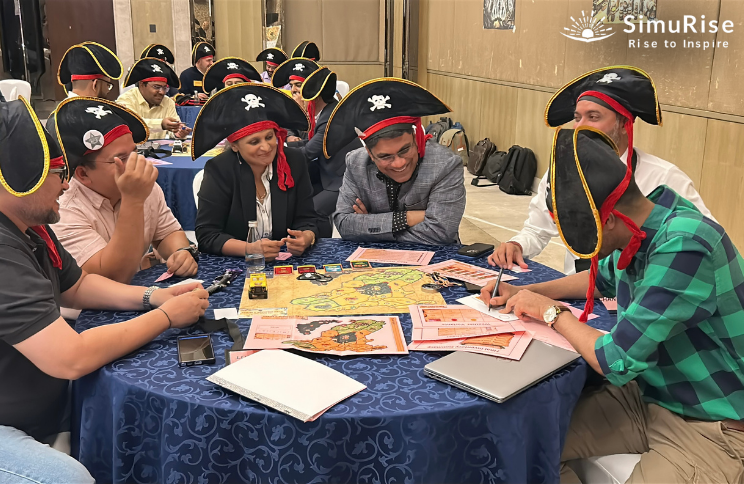
Some examples of these types of simulations are The Search for The Lost Dutchman’s Gold Mine and The Quest for King Solomon’s Mines. In these types of simulations, participants get to see what the dynamics of an internally competing team look like: hoarding resources, not asking for help, and focusing only on their own team’s success
Participants also get a chance to see the dramatic difference that an internally collaborative team makes: working together, sharing information with one another, working jointly towards a common goal, and looking beyond the interests of their own team.
Participants get to live out the consequences of their own competition and collaboration in a safe learning environment; the learning is amplified by physically experiencing both. During the guided debrief process, team members can connect their simulation experiences to their day-to-day realities in the workplace. They can identify where their organizations have created silos, where they have wasted resources, where trust has declined, and what behavior needs to change to achieve greater business success.
They begin to shift from ‘my team must win’ to ‘the whole organization must win.’
Key Takeaways
- Internal competition is natural, but when unmanaged, it becomes costly.
- The biggest costs are often invisible: missed opportunities, delayed decisions, lost innovation, low trust, and silent attrition.
- Toxic internal competition leads to productivity loss, poor communication, duplicated effort, weakened culture, and inconsistent customer experience.
- Organizations must redirect ambition toward shared goals and enterprise outcomes.
- Collaboration improves decision-making, innovation, engagement, customer experience, and long-term performance.
- Experiential learning helps teams experience the real impact of competition versus collaboration and commit to behaviour change.
Conclusion: The Real Competition Is Outside, Not Inside
Large organizations cannot afford to waste energy fighting internal battles. The real competition is outside the organization, in the market, in changing customer expectations, in technology shifts, and in emerging competitors.
Inside the organization, the goal should be collaboration.
When teams stop competing for credit and start working toward shared outcomes, the organization becomes faster, healthier, and more innovative. Resources are used better. Decisions improve. Employees feel more connected. Customers receive better value.
The strongest organizations are not those where every department wins separately.
They are the ones where the whole enterprise wins together.
To help your teams shift from internal competition to collaboration, reach out to marketing@simurise.com or connect with Annie at +91 9082381193.