Leadership development has become one of the most important investments organizations make today. Companies spend significant budgets on workshops, leadership offsites, coaching, assessments, learning journeys, and capability-building programs.
The intention is clear: to build better leaders, stronger teams, and more future-ready organizations.
But one question continues to challenge CHROs, L&D Heads, Business Leaders, and CFOs:
What is the real ROI of leadership development?
This question is important because organizations do not invest in leadership programs only to inspire participants for a day. They invest because leadership capability directly impacts collaboration, decision-making, execution, innovation, employee engagement, retention, customer experience, and business performance.
The challenge is that the ROI of leadership development is not always easy to measure. A sales training program may lead to faster revenue growth. A technical training program may show certification completion. But leadership development works differently. It changes thinking, behavior, culture, and performance over time.
That does not mean ROI cannot be measured. It means organizations need to measure the right things.
The Problem: Most Organizations Measure the Wrong Things
Many organizations measure leadership development through attendance, completion rates, feedback forms, and participant satisfaction scores.
These are useful indicators, but they do not prove real impact.
A program can receive excellent feedback and still create very little change in workplace behavior. A participant may say, “The session was useful,” but return to work and continue leading exactly the same way as before.
This is where many organizations miss the real value of leadership development. They measure whether people liked the program, but not whether the program changed how people lead, decide, collaborate, communicate, or execute.
Some common measurement gaps include:
- Overdependence on feedback forms
- No link between the program and business outcomes
- No behavioral baseline before the program
- Very short measurement timelines
- Limited manager involvement after the program
- No follow-up to track learning application
As a result, L&D teams may conduct powerful leadership programs but still struggle to demonstrate their value to business stakeholders.
What Does ROI in Leadership Development Really Mean?
ROI in leadership development should not be seen only as a financial number.
Financial impact matters, but leadership development creates value across multiple levels of the organization. A practical way to look at ROI is to ask:
What changed as a result of this leadership development experience?
That change may appear in different ways.
Some changes are visible as business outcomes, such as improved productivity, faster project execution, reduced attrition, higher sales performance, or better customer satisfaction.
Other changes are visible as behavioral outcomes, such as stronger decision-making, better ownership, improved collaboration, higher accountability, and clearer communication.
In leadership development, ROI can be measured across four important levels:
- Learning: Did participants gain new knowledge, tools, insights, and frameworks?
- Behavioral impact: Did participants apply what they learned back at work?
- Team Impact: Did teams experience better communication, trust, collaboration, and execution?
- Business Impact: Did the behavior change contribute to measurable organizational outcomes?
Many organizations expect business impact but do not properly track learning, behavior, or team-level changes. ROI becomes clearer when all four levels are connected.
Start with Business Outcomes, Not Program Content
The first step in measuring leadership development ROI is to define the business problem the program is meant to solve.
Too often, leadership programs begin with broad themes such as communication, collaboration, strategic thinking, or ownership. These are important, but they must be connected to a real business need.
Instead of saying:
“We want a leadership program on collaboration.”
A stronger starting point would be:
“We need leaders to improve cross-functional collaboration because project timelines are getting delayed due to poor alignment between teams.”
This changes the entire design and measurement of the program.
When the business outcome is clear, the required leadership behaviors become clear as well. This makes it easier to design the intervention, define success metrics, and measure ROI.
For example:
- If the goal is faster decision-making, measure decision speed and decision quality.
- If the goal is better collaboration, measure information sharing, cross-functional alignment, and team trust.
- If the goal is ownership, measure initiative-taking, follow-through, and accountability for outcomes.
- If the goal is a stronger leadership pipeline, measure role readiness, internal movement, and succession strength.
- The clearer the business problem, the stronger the measurement of impact.
Create a Baseline Before the Program Begins
You cannot measure transformation without knowing the starting point.
Before launching a leadership development program, organizations should create a baseline. This becomes the reference point for measuring progress after the intervention.
A baseline does not need to be complicated. It can include assessment results, manager feedback, employee surveys, performance data, and observation of current leadership behaviors.
Some useful baseline questions include:
- How well do leaders collaborate across functions?
- How quickly are critical decisions made?
- Do teams feel safe to speak up?
- Do leaders take ownership, or do they escalate every problem upward?
- What is the current level of engagement or attrition in teams led by participants?
- What business metrics are being affected by leadership gaps?
Without a baseline, success becomes subjective.
For example, if the objective is to improve ownership, the organization must first define what ownership currently looks like. Are leaders solving problems proactively? Are they following through on commitments? Are they taking accountability for outcomes? Are they empowering their teams to make decisions?
Once the current state is clear, progress becomes easier to measure.
Measure Behavior Change, Not Just Learning Completion
Leadership development is successful only when leaders demonstrate new behaviors at work.
A leader may attend a program on delegation, but real ROI appears only when that leader starts delegating more effectively, empowering team members, and reducing unnecessary dependency.
Similarly, a leader may learn about strategic thinking, but the impact becomes apparent only when they begin making more forward-looking decisions rather than reacting solely to immediate problems.
Behavior range can be measured through:
- Manager observations
- Team feedback
- Peer feedback
- Self-reflection reports
- 30-day, 60-day, and 90-day action plan reviews
- Action learning projects connected to real business challenges
This step is critical because it closes the gap between learning and performance.
If leadership behavior does not change, business results are unlikely to change.
Use the Kirkpatrick Model, But Apply It Practically
One of the most widely used approaches to evaluating training impact is the Kirkpatrick Model. It measures learning effectiveness across four levels: reaction, learning, behavior, and results.
For leadership development, this framework is useful when applied seriously.
Level 1: Reaction
Did participants find the program relevant, engaging, and useful?
Level 2: Learning
Did participants gain new tools, frameworks, insights, and understanding?
Level 3: Behavior. Did participants apply what they learned at work? Did they behave differently in meetings, reviews, conflict situations, or decision-making moments?
Level 4: Results
Did the behavior change contribute to business outcomes such as productivity, engagement, retention, customer satisfaction, faster execution, or stronger team performance?
The real value emerges when organizations connect all four levels, rather than measuring only participant satisfaction.
Follow-Up Is Where ROI Becomes Visible
Leadership development programs often fail to deliver sustained results because they lack structured follow-up.
A program may create powerful insight, but without reinforcement, participants can quickly return to old habits once workplace pressure resumes.
Every leadership development program should include a clear action plan.
A good action plan should answer:
- What specific behavior will the leader change?
- Where will this behavior be applied?
- Who will observe, support, or hold the leader accountable?
- What outcome should improve?
- When will progress be reviewed?
Follow-ups should ideally happen at 30, 60, and 90 days after the program. These checkpoints help participants stay focused and give organizations a practical way to track applications. Managers also play a critical role here. When managers are involved before and after the program, learning transfer becomes stronger. They can clarify expectations, observe progress, support behavior change, and connect learning to performance outcomes.
Without manager involvement, leadership development remains an isolated event. With manager involvement, it becomes part of performance improvement.
How Experiential Learning Makes ROI More Visible
One challenge with leadership development is that behavior is often hidden. In normal work settings, it may take months to observe how leaders respond to pressure, uncertainty, conflict, and resource constraints.
Experiential learning helps make these behaviors visible much faster.
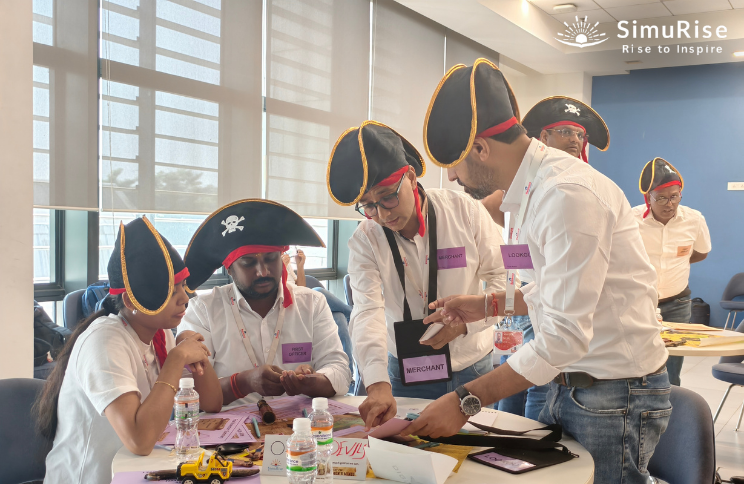
In a business simulation, leaders are placed in realistic situations where they must make decisions, collaborate, manage resources, take ownership, and respond to uncertainty.
Within a few hours, organizations can observe patterns such as:
- Who takes ownership?
- Who avoids risk?
- Who collaborates?
- Who works in silos?
- Who asks for help?
- Who makes strategic decisions?
- Who focuses only on short-term wins?
- Who adapts when circumstances change?
This creates powerful diagnostic value.
- The simulation experience creates observable behavior.
- The facilitated debrief creates reflection.
- The action planning creates a transfer back to work.
This makes experiential learning especially useful for measuring the impact of leadership development because it reveals both learning needs and behavioral shifts.
A Simple Framework to Measure Leadership Development ROI
Organizations can use a simple six-step framework to measure ROI more effectively.
1. Define the Business Problem
Start by identifying the business issue the program is meant to address. This could be due to slow execution, poor collaboration, weak ownership, low engagement, or gaps in the leadership pipeline.
2. Identify the Required Leadership Behaviors.
Ask what leaders are doing or not doing that contributes to the issue. For example, slow execution may be linked to unclear decision rights, poor delegation, risk avoidance, or lack of accountability.
3. Establish Baseline Metrics
Collect pre-program data through surveys, assessments, performance data, manager input, and feedback.
4. Design the Program Around Behavior Change
Ensure the program includes experience, reflection, tools, practice, and workplace application. Avoid designing it only around content.
5. Track Application Over Time
Use 30-day, 60-day, and 90-day follow-ups to measure whether participants are applying new behaviors at work.
6. Link Behavior Change to Business Results
Compare post-program changes with business metrics such as execution speed, collaboration, productivity, engagement, retention, or customer outcomes.
This framework keeps leadership development connected to real organizational priorities.
How SimuRise Helps Organizations Create Measurable Leadership Impact
At SimuRise, we believe leadership development should not stop at engagement. It should create visible shifts in behavior, mindset, and business performance.
Our experiential learning interventions and business simulations help organizations make leadership behaviors observable. Through simulations such as The Quest for King Solomon’s Mines, The Search for the Lost Dutchman’s Gold Mine, FreshBiz, Diamonds of Amazonia, and Square Wheels to Round Wheels, leaders experience real workplace dynamics in a safe but powerful environment.
They make decisions under pressure. They collaborate, compete, negotiate, plan, execute, and reflect. In the process, they see how their behaviors affect outcomes.
This creates a stronger foundation for ROI measurement because organizations can connect learning to:
- Behavioral insights during the simulation
- Reflection and debrief outcomes
- Action plans created after the program
- Post-program application at work
- Business priorities such as collaboration, ownership, strategy execution, and decision-making
The objective is not just to conduct a leadership development program. It is to help organizations build leaders who can create measurable impact.
Conclusion
Measuring the ROI of leadership development is not impossible. It becomes difficult only when programs are designed as isolated learning events without clear outcomes, baselines, behavior tracking, or follow-up.
When organizations begin with business outcomes, establish baselines, track behavior change, involve managers, and measure application over time, the impact becomes much clearer.
The real question is not whether leadership development creates ROI. Strong leadership always affects performance.
The real question is whether organizations are measuring the right things.
Leadership development should not be judged only by attendance or participant satisfaction. It should be evaluated by how leaders behave differently, how teams perform better, and how business outcomes improve.
If you want to create leadership development programs that go beyond engagement and deliver measurable behavioral and business impact, reach out to us at marketing@simurise.com or call Annie at +91 9082381193.