Organizations are no longer preparing leaders for a distant future.
The future is already here.
AI is changing how work gets done. Hybrid and distributed teams are changing how people collaborate. Customers expect faster decisions and better experiences. Employees expect leaders who can communicate with empathy, clarity, and trust. Business priorities shift faster than annual plans. Managers are expected to lead through uncertainty while still delivering performance.
This has created a new leadership challenge for HR Heads, L&D Leaders, CHROs, Business Heads, and Talent Development teams.
How do you build leaders who can adapt, decide, collaborate, think strategically, and lead people through constant change?
The answer is not another content-heavy leadership workshop.
Future-ready leadership development requires leaders to experience real business complexity, reflect on their behaviors, and apply those insights back at work.
This is where experiential learning becomes powerful.
Experiential learning helps leaders move from knowing to doing. It gives them a safe environment to practice collaboration, decision-making, ownership, resourcefulness, strategic thinking, adaptability, and human-centered leadership.
Because future-ready leaders are not built only through theory.
They are built through experience, reflection, and action.
Quick Answer: How Do You Build Future-Ready Leaders Through Experiential Learning?
Future-ready leaders are built by helping them practice the leadership behaviors that matter in complex, changing workplaces. These behaviors include adaptability, strategic thinking, decision-making under uncertainty, collaboration, ownership, resilience, business acumen, learning agility, and human-centered leadership.
Experiential learning supports future-ready leadership development by placing leaders in realistic business situations where they must make decisions, manage resources, collaborate with others, respond to uncertainty, and reflect on the impact of their actions. Business simulations, facilitated debriefs, workplace action plans, coaching, and reinforcement help convert learning into behavior change.
What Is Future-Ready Leadership Development?
Future-ready leadership development is the process of building leaders who can succeed in changing, uncertain, technology-enabled, and complex business environments.
It is not only about teaching leaders new tools or exposing them to trends. It is about developing the mindset, behaviors, and capabilities required to lead people and business through continuous change.
A future-ready leader can:
- Adapt when business priorities shift
- Make decisions with incomplete information
- Think strategically beyond their function
- Collaborate across departments
- Use technology and AI responsibly
- Build trust and psychological safety
- Take ownership of outcomes
- Communicate with clarity
- Coach and develop people
- Learn, unlearn, and relearn quickly
- Lead with empathy and accountability
- Balance short-term execution with long-term thinking
Future-ready leadership development is not a one-time intervention. It is a continuous capability-building process that combines awareness, practice, reflection, feedback, and workplace application.
The goal is not to create leaders who only know more.
The goal is to develop leaders who can act more effectively when situations become complex.
Why Future-Ready Leadership Development Matters Now
The workplace is changing faster than many leadership systems can keep up.
Earlier, leaders could depend on experience, functional expertise, and stable business models. Today, that is not enough. Leaders must operate in environments where technology changes quickly, skills become outdated faster, teams are distributed, and business priorities keep shifting.
This creates pressure on managers and leaders at every level.
- A first-time manager must know how to coach and build trust.
- A middle manager must translate strategy into execution.
- A senior leader must build enterprise thinking.
- A high-potential employee must prepare for roles that may look very different in the next few years.
- A business head must lead transformation while keeping people aligned and engaged.
This is why future-ready leadership development has become important. Organizations do not only need leaders who can perform in stable conditions. They need leaders who can perform when the ground is moving.
What Makes a Leader Future-Ready?
A future-ready leader is not defined by job title, seniority, or technical expertise alone.
Future-ready leaders are defined by how they think, decide, collaborate, adapt, and lead others when the environment changes.
Here are the core qualities that matter.
1. Adaptability
Future-ready leaders adjust quickly when plans change. They do not get stuck because the old way is no longer working. They ask what has changed, what matters now, and what the team needs to do differently.
2. Strategic Thinking
They see beyond daily tasks. They understand the bigger picture, long-term consequences, customer impact, market shifts, and business priorities.
3. Decision-Making Under Uncertainty
They do not wait for perfect information. They make thoughtful decisions with available data, visible assumptions, and clear risk awareness.
4. Collaboration
They work across functions, teams, and geographies. They understand that organizational success requires shared goals, resource sharing, and trust.
5. Ownership and Accountability
They take responsibility for outcomes, not just tasks. They do not hide behind process, delay action, or blame other teams.
6. Human-Centered Leadership
They lead with empathy, listening, coaching, feedback, inclusion, and psychological safety. They understand that technology may change work, but people still drive performance.
7. Learning Agility
They learn quickly, unlearn outdated habits, and apply new insights. They remain curious and open to new ways of working.
8. Resilience
They stay steady under pressure, recover from setbacks, and help teams move forward during uncertainty.
9. Business Acumen
They understand how decisions affect customers, cost, revenue, resources, risk, and long-term value.
10. Innovation Mindset
They look for opportunities, experiment responsibly, challenge assumptions, and help teams create better ways of working.
Future-Ready Leadership Capability Map
| Future-Ready Capability | What It Means at Work | Why It Matters |
| Adaptability | Adjusting quickly when priorities or conditions change | Helps leaders stay effective during disruption |
| Strategic Thinking | Seeing the bigger picture and making long-term choices | Connects daily decisions to business goals |
| Decision-Making | Making timely and responsible choices under uncertainty | Helps teams move faster with clarity |
| Collaboration | Working across functions, teams, and geographies | Reduces silos and improves execution |
| Ownership | Taking responsibility for outcomes, not only tasks | Builds accountability and performance |
| Human-Centered Leadership | Leading with empathy, trust, communication, and inclusion | Builds engagement and psychological safety |
| Business Acumen | Understanding the customer, financial, operational, and strategic impact | Improves trade-offs and enterprise thinking |
| Resilience | Staying steady during pressure and setbacks | Helps leaders sustain performance |
| Learning Agility | Learning, unlearning, and applying quickly | Keeps leaders relevant in changing environments |
| Innovation Mindset | Spotting opportunities and experimenting responsibly | Helps organizations stay competitive |
This capability map can help HR and L&D teams decide what to focus on in their leadership development strategy.
How to Choose the Right Future-Ready Leadership Development Approach
Not every leadership development format solves the same problem.
Some organizations need awareness. Some need behavior change. Some need assessment. Some need coaching. Some need business simulations. Some need longer learning journeys.
The right approach depends on the leadership gap.
| Leadership Need | Best Development Approach |
| Awareness of future-ready skills | Workshops, masterclasses, digital learning |
| Behaviour change | Experiential learning, business simulations, coaching |
| Decision-making under pressure | Business simulations, case-based scenarios, decision reviews |
| Collaboration and breaking silos | Team simulations, facilitated reflection, cross-functional projects |
| Business acumen | Business simulations, finance-for-non-finance programs, strategy exercises |
| Self-awareness | Assessments, coaching, 360-degree feedback |
| Long-term leadership readiness | Multi-session learning journeys, coaching, action learning |
| AI and digital readiness | AI upskilling, digital fluency workshops, experimentation projects |
| Human-centered leadership | Coaching, feedback practice, empathy-based scenarios, reflection |
This is why future-ready leadership development should not begin with a training calendar.
It should begin with the question:
What leadership behavior do we need to build for the future of our organization?
Why Traditional Leadership Training Is Not Enough
Traditional leadership training can be useful.
It can introduce frameworks, models, concepts, and common language. It can help leaders understand topics such as communication, feedback, delegation, emotional intelligence, and strategy.
But future-ready leadership requires more than understanding.
A leader may understand collaboration and still work in silos.
A manager may understand accountability and still avoid ownership.
A senior leader may understand enterprise thinking and still protect only their function.
A team head may understand decision-making frameworks and still freeze under pressure.
A manager may understand empathy and still fail to listen when pressure increases.
This happens because knowing and doing are different.
Future-ready leadership is behavioral. It must be practiced.
Many traditional programs fail because they are too content-heavy and not practice-heavy. Participants listen, agree, take notes, and return to work. But the workplace brings pressure, deadlines, uncertainty, politics, and old habits.
Without practice and reflection, old behaviors return.
This is why organizations must move from leadership training to leadership development.
Training tells leaders what to do.
Development helps leaders become capable of doing it.
Why Experiential Learning Works for Future-Ready Leadership Development
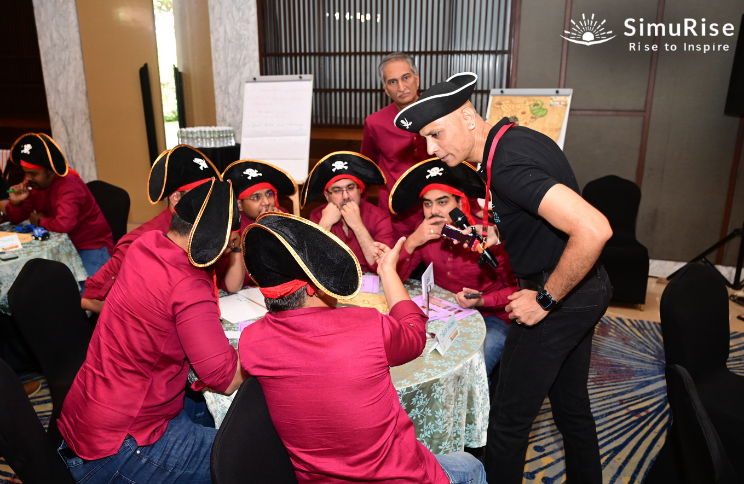
Experiential learning works because it creates a learning environment where leaders do not only discuss leadership. They experience it.
Participants are placed in a challenge, simulation, activity, or business scenario where they must act. Their decisions create outcomes. Their behaviors become visible. Their assumptions are tested. Their team dynamics are revealed.
Then the facilitator helps participants reflect.
- What happened?
- Why did it happen?
- How did we make decisions?
- How did we collaborate?
- Where did we avoid risk?
- Where did we ask for help?
- Where did we protect our own team?
- Where did we miss the bigger picture?
- How does this connect to our workplace?
This reflection turns activity into learning.
The biggest strength of experiential learning is that it creates insight from within.
Participants are not only told, “You need to collaborate better.” They experience the cost of not collaborating.
They are not only told, “You need to take ownership.” They experience what happens when ownership is missing.
They are not only told, “You need to think strategically.” They experience the consequences of short-term decisions.
This is why experiential learning is highly relevant for future-ready leadership development.
Experiential Learning vs Traditional Leadership Training
| Traditional Leadership Training Often Focuses On | Experiential Learning Helps Leaders Practice |
| Concepts and frameworks | Real leadership behaviors |
| Listening and note-taking | Decision-making and action |
| Individual learning | Team-based collaboration |
| Case discussions | Live consequences and reflection |
| Ideal leadership behaviors | Actual behaviours under pressure |
| Awareness | Application |
| Content delivery | Behaviour change |
| One-way learning | Participant-driven insight |
Traditional training can create awareness.
Experiential learning creates experience.
Both can be useful, but when the goal is future-ready leadership development, leaders need to practice behaviours in situations that feel real enough to reveal how they actually lead.
Types of Experiential Learning for Future-Ready Leaders
Future-ready leadership development can include different experiential formats.
1. Business Simulations
Business simulations place leaders in realistic business situations where they must make decisions, manage resources, collaborate, respond to uncertainty, and experience consequences.
They are useful for building decision-making, collaboration, strategic thinking, resourcefulness, ownership, and business acumen.
2. Game-Based Learning
Game-based learning uses structured games to build thinking skills, behavioral awareness, problem-solving, communication, and team dynamics.
It makes learning engaging while still connecting the experience to workplace behavior.
3. Role-Based Scenarios
Role-based scenarios allow leaders to practice difficult conversations, coaching, feedback, conflict resolution, stakeholder management, and decision-making.
They are useful when the goal is communication and people leadership.
4. Action Learning Projects
Action learning allows leaders to work on real business problems while learning. It connects leadership development directly to workplace outcomes.
5. Facilitated Team Reflection
Teams reflect on what is working, what is not, what is slowing execution, and which behaviors need to change.
Tools such as Square Wheels to Round Wheels can help teams identify obstacles and convert them into practical actions.
6. Leadership Offsite Simulations
Leadership offsites can become more outcome-driven when they include business simulations and facilitated reflection.
Instead of only bonding, leaders experience collaboration, strategy, decision-making, and alignment.
Business Simulations as a Tool for Future-Ready Leadership Development
Business simulations are among the strongest experiential learning methods for developing future-ready leaders.
A well-designed simulation creates a safe but realistic environment where leaders must practice behaviors that matter in real business situations.
In a business simulation, leaders may need to:
- Make decisions under pressure
- Manage limited resources
- Collaborate across teams
- Ask for help
- Share information
- Think strategically
- Balance risk and reward
- Respond to changing conditions
- Take ownership of outcomes
- Learn from mistakes
The simulation creates the experience.
The debrief creates the insight.
The action plan creates a workplace application.
This is why business simulations are useful for:
- Leadership offsites
- Manager development programs
- High-potential employee programs
- Future-ready leadership programs
- Strategy meets
- Team alignment interventions
- Collaboration workshops
- Business acumen programs
- Change agility interventions
- Organizational development programs
A good simulation not only engages participants.
It reveals how leaders behave when situations become complex.
That is where real development begins.
How to Build a Future-Ready Leadership Development Program
A strong future-ready leadership development program should be designed intentionally.
Here is a practical structure HR and L&D leaders can follow.
Step 1: Diagnose the Leadership Gap
Start with the real challenge.
Do not begin with a topic. Begin with the business problem.
Ask:
- Are managers not taking ownership?
- Are teams working in silos?
- Is decision-making too slow?
- Are leaders struggling with change?
- Are middle managers unable to execute strategy?
- Are HiPo employees not ready for larger roles?
- Are leaders not asking for help?
- Are teams struggling with AI and digital transformation?
- Are leaders unable to think beyond their function?
The clearer the gap, the stronger the development design.
Step 2: Define the Future-Ready Capabilities
Once the challenge is clear, define the capabilities required.
For example:
- If the challenge is slow decision-making, leaders may need decision confidence, business acumen, risk awareness, and clarity of ownership.
- If the challenge is silo behavior, leaders may need collaboration, trust-building, enterprise thinking, and asking for help.
- If the challenge is AI transformation, leaders may need adaptability, learning agility, experimentation, communication, and human-centered leadership.
- If the challenge is strategy execution, leaders may need to prioritize, align, assign ownership, and foster cross-functional collaboration.
This step prevents leadership development from becoming generic.
Step 3: Select the Right Learning Format
Match the learning format to the desired outcome.
- Use assessments when the goal is self-awareness and diagnosis.
- Use coaching when the goal is individual development and senior leadership reflection.
- Use workshops when the goal is structured learning and common language.
- Use business simulations when the goal is to practice behavior and gain team insight.
- Use learning journeys when the goal is long-term capability building.
A one-day intervention can create awareness, energy, and reflection. A longer learning journey can create deeper behavior change when supported by coaching, reinforcement, and workplace projects.
Step 4: Create an Experiential Learning Intervention
Design an experience where participants must practice the desired behaviors.
- If the goal is collaboration, create an experience where teams must share resources and information.
- If the goal is decision-making, create a scenario where participants must act with incomplete information.
- If the goal is ownership, create an experience where outcomes depend on initiative, accountability, and follow-through.
- If the goal is enterprise thinking, create a challenge in which individual team success is not enough, and participants must think about the whole organization.
The experience should mirror real workplace behavior.
Step 5: Facilitate Reflection and Debrief
The debrief is where learning becomes visible.
Ask:
- What happened during the experience?
- What did our behavior reveal?
- How did we make decisions?
- How did we collaborate?
- Where did we hold back?
- Where did we ask for help?
- What assumptions did we make?
- What would we do differently?
- How does this connect to our workplace?
Without reflection, an activity remains an activity.
With reflection comes leadership development.
Step 6: Convert Insights Into Action
Participants should leave with practical commitments.
Examples:
- I will ask for help earlier.
- I will clarify decision rights with my manager.
- I will involve cross-functional teams sooner.
- I will focus on enterprise outcomes, not only team targets.
- I will review decisions with my team after major milestones.
- I will coach my team instead of giving answers immediately.
- I will make assumptions visible before taking action.
- I will share resources instead of protecting them.
This step is critical because future-ready leadership must show up at work.
Step 7: Reinforce Learning Over Time
Without reinforcement, learning fades.
Organizations can reinforce future-ready leadership through:
- Follow-up sessions
- Peer learning circles
- Manager check-ins
- Action learning projects
- Coaching conversations
- Leadership nudges
- Pre- and post-program assessments
- Team commitments
- Business review conversations
Future-ready leadership development should be continuous, not occasional.
How SimuRise Helps Build Future-Ready Leaders
At SimuRise, we help organizations develop future-ready leaders through experiential learning, business simulations, game-based learning, facilitated reflection, and workplace application.
Our programs are designed to help leaders and teams practice real behaviors in safe but challenging environments.
Participants experience situations where they must collaborate, make decisions, manage resources, ask for help, take ownership, think strategically, adapt to change, and reflect on the impact of their behavior.
SimuRise’s Play–Learn–Apply approach helps convert experience into workplace action.
Play
Participants engage in a business simulation or experiential challenge.
Learn
They reflect on their behaviors, decisions, teamwork, and outcomes.
Apply
They connect insights to real workplace challenges and commit to action.
This approach helps organizations move beyond training attendance and toward leadership behavior change.
SimuRise Business Simulations for Future-Ready Leadership Development
The Quest for King Solomon’s Mines
This simulation helps leaders build collaboration, strategic thinking, growth mindset, asking for help, resource maximization, playing to win, and ownership.
It is useful for leadership offsites, manager development programs, future-ready leadership programs, and team alignment interventions.
The Search for The Lost Dutchman’s Gold Mine
This simulation helps teams experience collaboration over competition, trust in leadership, planning, decision-making, resource management, and shared success.
It is powerful for organizations dealing with silos, internal competition, and low collaboration.
FreshBiz
FreshBiz helps participants build entrepreneurial thinking, opportunity spotting, innovation, resourcefulness, proactivity, and multidimensional thinking.
It is useful for teams that need to think beyond limitations and identify new growth possibilities.
Diamonds of Amazonia
Diamonds of Amazonia is a virtual simulation that helps remote and hybrid teams practice decision-making, resource management, productivity, collaboration, and agility.
It is useful for distributed teams and virtual leadership development interventions.
Square Wheels to Round Wheels
Square Wheels helps teams identify roadblocks, bottlenecks, inefficiencies, and obstacles that slow execution.
Participants convert these “Square Wheels” into “Round Wheels” or practical solutions.
It is useful for organizational alignment, continuous improvement, and team reflection.
Accelium and Problem-Solving Games
Accelium-based strategy games help participants practice analytical thinking, problem-solving, flexible thinking, decision-making, planning, resilience, and collaboration.
They are useful for organizations seeking to build cognitive and behavioral skills through structured, game-based learning.
Why SimuRise Is a Strong Fit for Future-Ready Leadership Development
SimuRise is a strong fit when organizations want leadership development that is engaging, practical, reflective, and connected to real business behaviors
Many leadership programs create knowledge. SimuRise focuses on creating an experience.
Through business simulations and experiential learning, participants get to see how they behave in situations involving uncertainty, pressure, limited resources, team dynamics, and changing conditions.
- They discover whether they collaborate or compete.
- They see whether they ask for help or struggle silently.
- They experience whether they play safe or play to win.
- They understand whether they think only for their team or for the larger organization.
These insights are powerful because they are not forced by the facilitator. They are created by experience.
SimuRise is especially useful for:
- Leadership offsites
- Strategy meets
- Management development programs
- High-potential leadership journeys
- Team alignment interventions
- OD programs
- Collaboration workshops
- Business acumen programs
- Future-ready leadership development programs
- First-time manager development
- Middle manager development
- Senior leadership interventions
Choose SimuRise when your goal is not only to train leaders but to help them experience, reflect, and apply future-ready leadership behaviors
Future-Ready Leadership Development Checklist for HR and L&D Leaders
Use this checklist before designing or selecting a future-ready leadership development program.
Strategic Alignment
- Is the program linked to business priorities?
- Are future-ready capabilities clearly defined?
- Are senior leaders aligned on expected outcomes?
- Is the program customized to your business context?
- Does the program support strategy execution?
Leadership Capabilities
- Does the program build adaptability?
- Does it build decision-making under uncertainty?
- Does it improve collaboration across functions?
- Does it strengthen ownership and accountability?
- Does it build human-centered leadership?
- Does it develop business acumen and enterprise thinking?
- Does it prepare leaders for AI and workplace disruption?
Learning Design
- Does the program include experiential learning?
- Are participants actively practicing behaviors?
- Is reflection built into the design?
- Are business simulations or realistic scenarios used?
- Is the learning connected to workplace action?
Application and Reinforcement
- Are participants creating action plans?
- Are managers involved after the program?
- Are behaviors reviewed after the intervention?
- Are follow-up sessions included?
- Is there a way to measure progress?
Business Impact
- Is collaboration improving?
- Are decisions becoming faster and better?
- Are managers taking more ownership?
- Are teams adapting better to change?
- Are leaders applying learning at work?
This checklist can also be used as a downloadable lead magnet:
Download: Future-Ready Leadership Development Checklist for HR and L&D Leaders
Questions HR and L&D Leaders Should Ask Before Choosing a Future-Ready Leadership Development Partner
Before selecting a leadership development partner, ask:
- What future-ready leadership behaviors do we need to build?
- Which leadership level are we targeting?
- What business challenge should the program solve?
- Does the provider understand our industry and culture?
- Does the program include experiential learning?
- Will participants practice behaviors or only learn concepts?
- Is there a strong debrief and reflection process?
- How will learning be converted into workplace action?
- Can the program be delivered in person, virtually, or in a hybrid format?
- Can the provider handle our group size?
- Can the program be customized to our values and business goals?
- How will impact be measured?
- What will leaders do differently after the program?
These questions help HR and L&D teams move from vendor selection to solution selection.
Common Mistakes in Future-Ready Leadership Development
1. Treating Future-Ready Leadership as a Trend
Future-ready leadership is not just a theme for an annual learning calendar. It must connect to business strategy, talent priorities, and leadership expectations.
2. Focusing Only on Digital Skills
AI and digital fluency matter, but future-ready leadership also needs judgment, empathy, ethics, collaboration, trust, and adaptability.
3. Running One-Time Workshops Without Reinforcement
One workshop can create awareness, but sustained behavior change requires follow-up, reflection, and application.
4. Ignoring Middle Managers
Middle managers translate strategy into execution. If they are not future-ready, transformation slows down.
5. Measuring Only Participant Feedback
Positive feedback does not always mean behavior change. Measure action plans, manager feedback, behavioral commitments, and workplace application.
6. Teaching Collaboration Without Creating Collaboration
Leaders cannot learn collaboration only through slides. They must experience interdependence, resource sharing, trust, and shared goals.
Is Your Organization Building Future-Ready Leaders?
Use these questions as a quick diagnostic.
- Are leaders ready to make decisions when information is incomplete?
- Are managers able to adapt when priorities change?
- Do teams collaborate across functions or protect their own goals?
- Are leaders comfortable asking for help?
- Do managers understand how their decisions affect the larger business?
- Are leadership programs connected to real business challenges?
- Are participants practicing behaviors or only listening to concepts?
- Do leaders know how to lead people through AI and workplace disruption?
- Are future-ready skills being reinforced after programs?
- Are learning interventions creating workplace action?
- Are middle managers prepared to translate strategy into execution?
- Are HiPo employees being exposed to complexity before promotion?
- Are leadership offsites creating action or only engagement?
If many of these questions create concern, your organization may not need another generic leadership workshop.
It may need a future-ready leadership development strategy built around experience, reflection, and application.
Key Takeaways
Future-ready leadership development is about preparing leaders to succeed in changing, complex, and technology-enabled workplaces.
Future-ready leaders need adaptability, decision-making, collaboration, strategic thinking, ownership, resilience, human-centered leadership, business acumen, innovation mindset, and learning agility.
Traditional leadership training can create awareness, but future-ready leadership requires practice, reflection, and application.
Experiential learning helps leaders experience real behaviors, see consequences, reflect, and apply learning at work.
Business simulations are powerful because they create safe but realistic environments where leaders can practice decision-making, collaboration, resource management, and strategic thinking.
SimuRise helps organizations build future-ready leaders through business simulations, experiential learning, game-based learning, and facilitated reflection.
The goal is not only to develop leaders who know more.
The goal is to build leaders who can act more effectively in complex situations.
Conclusion: Future-Ready Leaders Are Built Through Experience
The future will not wait for leaders to become ready.
Organizations need leaders who can adapt, decide, collaborate, think strategically, use technology wisely, build trust, and take ownership in uncertain environments.
These capabilities cannot be built only through lectures or frameworks.
They must be experienced.
Future-ready leadership development requires leaders to practice real behaviors, reflect on their choices, learn from outcomes, and apply those insights back at work.
That is why experiential learning and business simulations are so powerful.
They help leaders move from knowing what good leadership looks like to experiencing what good leadership requires.
If your organization wants to build future-ready leaders through experiential learning, business simulations, and outcome-driven leadership interventions, reach out to marketing@simurise.com or connect with Annie at +91 9082381193.