Introduction
Cross-functional teams are often seen as the engine of innovation. When people from different functions come together, they bring different skills, experiences, perspectives, and problem-solving styles. In theory, this should help organizations solve complex problems faster, improve decision-making, and create better business outcomes.
A product team may bring customer and user insights. Engineering may bring technical depth. Marketing may understand positioning and demand. Sales may know customer objections and buying behavior. Operations may understand scale, risk, and delivery feasibility. Finance may bring commercial discipline.
When all of this comes together well, cross-functional teams can create extraordinary results.
But in many organizations, that promise does not always translate into performance.
Projects get delayed. Priorities keep shifting. Teams blame each other. Meetings increase, but clarity does not. Dependencies are missing. Decisions get escalated. Everyone looks busy, but the project is not moving at the expected speed or quality.
The problem is rarely a lack of talent.
The real problem is an alignment gap.
Cross-functional projects do not fail because people are not capable. They fail because different functions often operate with different goals, assumptions, success metrics, and versions of reality.
Why Cross-Functional Projects Are Difficult by Design
Cross-functional work is naturally complex because people from different functions do not always work in the same way. Each function has its own priorities, vocabulary, rhythm, decision-making style, and definition of success.
Marketing may focus on speed, messaging, visibility, and market demand. Product may focus on user experience, product quality, and roadmap discipline. Engineering may prioritize technical stability, system quality, and feasibility. Operations may focus on scalability, risk, and execution discipline. Sales may want speed and flexibility to respond to customer demand. Finance may look at cost, commercial viability, and business discipline.
Each of these priorities is valid.
The challenge begins when they are not aligned.
When cross-functional projects operate without alignment, each function optimizes for its own success rather than the overall project’s success. Engineering may build a technically strong solution that does not fully meet customer needs. Marketing may launch a campaign before the product is ready. Sales may commit to timelines without understanding delivery complexity. Leadership may change priorities without considering downstream impact.
When this happens, the project becomes a collection of separate functional efforts rather than a unified mission.
This is why alignment must come before execution.
The Real Reason Cross-Functional Projects Fail
Many leaders assume that cross-functional projects fail because of poor coordination. In response, they add more meetings, reviews, tools, dashboards, and reporting systems.
But coordination is not the same as alignment.
Coordination is about organizing activities. Alignment is about building shared understanding.
A cross-functional project may have many meetings and still fail if people are not clear on the outcome, ownership, dependencies, decision rights, priorities, trade-offs, and success metrics.
The real reason cross-functional projects fail is that teams are often connected through workflow but disconnected through purpose.
They may be working on the same project, but they are not always working toward the same goal.
1. Competing Goals Create Conflicting Priorities
One of the biggest reasons cross-functional teams struggle is the absence of a shared purpose.
Each department usually has its own goals. Marketing may focus on growth and reach. The product may focus on usability and feature completion. Engineering may focus on clean architecture and technical quality. Operations may focus on reliability and scalability. Sales may focus on speed and customer commitments. Finance may focus on cost control and commercial discipline.
All these goals are important. But when there is no common project goal, every function continues to make decisions based on its own priorities.
This creates friction.
A timeline that works for Sales may put pressure on Engineering. A feature that looks attractive to customers may create operational complexity. A cost-saving decision may affect service quality. A marketing campaign may create demand before the business is ready to deliver.
Without a shared success measure, cross-functional collaboration becomes difficult. People may worry that supporting another department will hurt their own KPIs.
Cross-functional teams need shared goals above departmental goals. Otherwise, each function will continue to protect its own scorecard.
2. Different Functional Cultures Lead to Misunderstanding
Every function has its own working culture.
Marketing may operate with urgency, creativity, and campaign deadlines. Engineering may involve structure, precision, and a discipline of problem-solving. Finance may value control, accuracy, and risk management. Sales may move with speed, persuasion, and customer pressure. Operations may focus on process, stability, and consistency.
These differences are natural.
The problem begins when teams do not understand one another’s working style. What one function sees as speed, another may see as a lack of planning. What one team sees as caution, another may see as resistance. What one group sees as quality discipline, another may see as unnecessary delay.
Over time, teams may stop seeing positive intent. They begin to interpret differences as opposition.
Cross-functional collaboration requires teams to understand not only what other functions do, but also how they think. Without this understanding, the diversity of functions becomes a source of conflict instead of strength.
3. Unclear Ownership Creates Delay and Blame
Cross-functional projects often struggle because ownership is unclear.
Everyone participates, but no one is clearly accountable for the final outcome. People attend meetings, provide updates, complete their part of the work, and wait for others to move. But when the project slips, it becomes difficult to determine who is responsible for the outcome.
Some common ownership questions remain unanswered:
- Who ultimately makes the decision?
- Who is accountable for the customer outcome?
- Who owns the dependencies?
- Who approves the trade-offs?
- Who escalates the risks?
- Who keeps the project aligned?
When ownership is unclear, teams spend too much time debating authority. Decisions slow down because no one knows who has the right to decide. Issues get passed between departments, and when things go wrong, blame begins to surface.
Cross-functional projects need clear decision frameworks. Tools such as DACI, RACI, or simple decision-rights maps can help clarify who drives, who approves, who contributes, and who needs to be informed.
Role clarity does not reduce collaboration. It strengthens it.
4. Hidden Dependencies Create Last-Minute Surprises
Cross-functional projects often fail because teams do not fully understand how their work affects one another.
Engineering may need final product specifications before development can move forward. Marketing may need confirmed launch dates. Sales may need pricing, product details, and customer messaging. Customer service may need training material before the launch. Operations may need enough time to prepare delivery capacity.
When these dependencies are not visible, they become risks.
This leads to last-minute surprises, rushed decisions, missed deadlines, and unnecessary conflict. Many projects do not fail because people did not work hard. They fail because teams did not map how their work was connected.
Dependency visibility is essential for cross-functional execution.
This can be created through shared dashboards, dependency maps, milestone reviews, risk discussions, and regular alignment conversations. The goal is not to control everything. The goal is to make the work visible enough for teams to act before small issues become major delays.
5. Communication Becomes Status Reporting Instead of Strategic Discussion
Many cross-functional teams communicate frequently, but not effectively.
They share updates but do not discuss risks. They report progress but do not question assumptions. They attend meetings but leave without resolving conflicts. They exchange information, but do not build shared understanding.
This gives the appearance of alignment without creating real alignment.
Strong cross-functional communication must go beyond status reporting. Teams need to ask deeper questions:
- What outcome are we trying to achieve?
- What has changed?
- What is at risk?
- What decision needs to be made?
- What dependency needs attention?
- What trade-off do we need to make?
- Who needs support?
- Where are we misaligned?
When communication stays only at the level of updates, teams miss the conversations that actually create alignment.
6. Leadership Sends Mixed Signals
Cross-functional teams often mirror the alignment, or misalignment, of senior leaders.
If functional leaders are not aligned, the project team will feel it. If leaders keep changing priorities without clarity, teams will become uncertain. If leaders reward only functional success and ignore collective outcomes, cross-functional collaboration will weaken.
Teams take cues from what leaders value.
If leaders speak about collaboration but reward individual departments only for their own scorecards, people will protect functional priorities. If leaders expect alignment but do not model it themselves, the team will struggle to trust the process.
Leadership alignment is critical.
Leaders must clarify the larger goal, remove conflicting priorities, model collaboration, encourage accountability, and reinforce collective success.
7. Tools Are Used Without Behavior Change
Many organizations try to solve cross-functional problems with tools.
They introduce Slack, Teams, Trello, Asana, Jira, dashboards, project trackers, workflows, and reporting systems. These tools can support collaboration, but they cannot solve deeper relational and alignment challenges on their own.
- A tool cannot create trust.
- A dashboard cannot solve unclear ownership.
- A tracker cannot resolve competing priorities.
- A communication platform cannot replace honest conversations.
- Tools are meant to support collaboration, not replace it.
Without shared goals, decision rights, leadership alignment, and trust, tools only make existing dysfunction more visible.
How to Make Cross-Functional Projects Work
The solution is not more meetings. The solution is stronger alignment, clearer ownership, visible dependencies, better trust, and shared accountability.
1. Start with Shared Outcomes
Every cross-functional project should begin by answering one question:
What outcome are we collectively responsible for?
This outcome must be larger than any one department’s KPI.
Instead of separate goals such as marketing growth, product launch, or sales conversion, the team should define a shared success metric, such as customer adoption, improved retention, faster time-to-market, improved service experience, or revenue impact.
When teams share the same outcome, decision-making becomes easier.
2. Build Psychological Trust Before Task Pressure
Trust is the foundation of cross-functional collaboration.
Without trust, people hide problems, avoid difficult conversations, defend their function, and hesitate to ask for help. With trust, teams can disagree productively, raise risks early, and solve problems faster.
Leaders can build trust by encouraging openness, listening without interruption, admitting mistakes, following through on commitments, and creating space for honest feedback.
Task clarity matters. But trust must come first, because people will not fully commit to shared work if they do not feel safe with one another.
3. Clarify Roles, Boundaries, and Decision Rights
Cross-functional teams need both flexibility and clarity.
People should be open to contributing beyond their narrow roles, but they also need to know who owns what. Without boundaries, collaboration becomes confusion.
At the start of the project, teams should define:
- Who is the driver?
- Who approves decisions?
- Who contributes expertise?
- Who must be informed?
- Who owns each milestone?
- Who manages risks and dependencies?
This reduces conflict and speeds up execution.
4. Make Dependencies Visible
Teams should not wait for a delay to occur to discover a dependency.
A simple dependency map can show who needs what, from whom, and by when. Shared dashboards can make risks visible. Weekly alignment conversations can help teams identify changes early.
The goal is not to control everything. The goal is to make the work visible enough for teams to respond before small issues become major delays.
5. Create Regular Alignment Rhythms
Cross-functional alignment is not a one-time activity. It must be maintained throughout the project.
Teams need regular check-ins focused on outcomes, risks, dependencies, decisions, and learning. These conversations should not become routine status updates. They should help the team stay connected to the larger purpose and adapt as work evolves.
Good alignment rhythms prevent teams from drifting back into functional silos.
6. Reward Collective Success
If people are measured only on functional targets, they will behave in ways that are functional.
Organizations must recognize and reward cross-functional contribution. This includes shared metrics, public recognition of collaboration, and performance conversations that incorporate enterprise impact.
When collective success is rewarded, collaboration becomes real.
7. Use Retrospectives to Learn Across Functions
After major milestones, teams should reflect together.
They should ask:
- What worked well?
- Where did friction appear?
- Which dependency was missed?
- Where did communication break down?
- What should we do differently next time?
Cross-functional retrospectives create learning loops. They help the organization improve not just the project, but also the way teams work together.
How SimuRise Can Help Cross-Functional Teams Collaborate Better
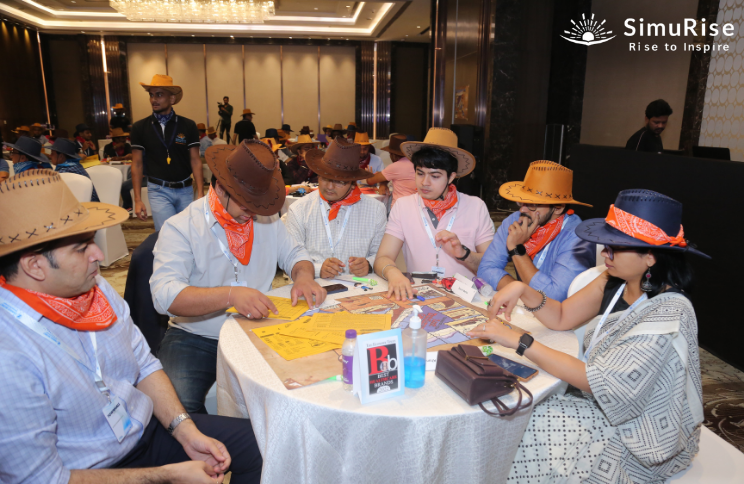
At SimuRise, we help organizations build stronger cross-functional collaboration through experiential learning, business simulations, and facilitated reflection.
Cross-functional challenges cannot be solved only through presentations or frameworks. Teams need to experience what happens when they work in silos, mismanage resources, delay decisions, avoid asking for help, or fail to communicate.
Through simulations such as The Quest for King Solomon’s Mines, The Search for the Lost Dutchman’s Gold Mine, FreshBiz, Diamonds of Amazonia, and Square Wheels to Round Wheels, participants experience realistic collaboration challenges in a safe environment.
- They see how competing goals affect results.
- They experience the cost of poor communication.
- They understand the importance of asking for help.
- They learn how shared goals improve outcomes.
- They reflect on how their behaviors impact the larger team.
The simulation creates the experience.
The debrief creates the insight.
The workplace action plan creates an application.
This helps cross-functional teams move from coordination to true alignment.
Key Takeaways
- Cross-functional projects usually fail because of alignment gaps, not talent gaps.
- More meetings do not solve unclear goals, hidden dependencies, weak trust, or competing priorities.
- Shared outcomes are essential for cross-functional success.
- Psychological trust must come before honest collaboration.
- Decision rights, role clarity, and visible dependencies reduce friction.
- Leadership alignment is critical because teams copy what leaders model.
- Experiential learning helps teams practice collaboration behaviors before real business pressure exposes the gaps.
Conclusion
- Cross-functional teams show how an organization functions in reality.
- If there is little trust, a cross-functional team will show it.
- If goals are unclear, the cross-functional team will show it.
- If leaders are not aligned, the cross-functional team will show it.
- If systems reward siloed behavior, a cross-functional team will expose it.
Because of this, cross-functional project failure is rarely only a project management issue. It is also a leadership, culture, and alignment issue.
Successful organizations will not be the ones with the most tools or the most meetings. They will be the ones with shared outcomes, strong trust, clear ownership, visible dependencies, aligned leadership, and motivated teamwork.
Successful cross-functional working relationships do not happen simply because people are working together.
They happen because people are winning together.
To strengthen cross-functional collaboration in your teams through experiential learning and business simulations, reach out to marketing@simurise.com or connect with Annie at +91 9082381193.